
The tried and tested RUWI lift tables with 20 mm clamping technology



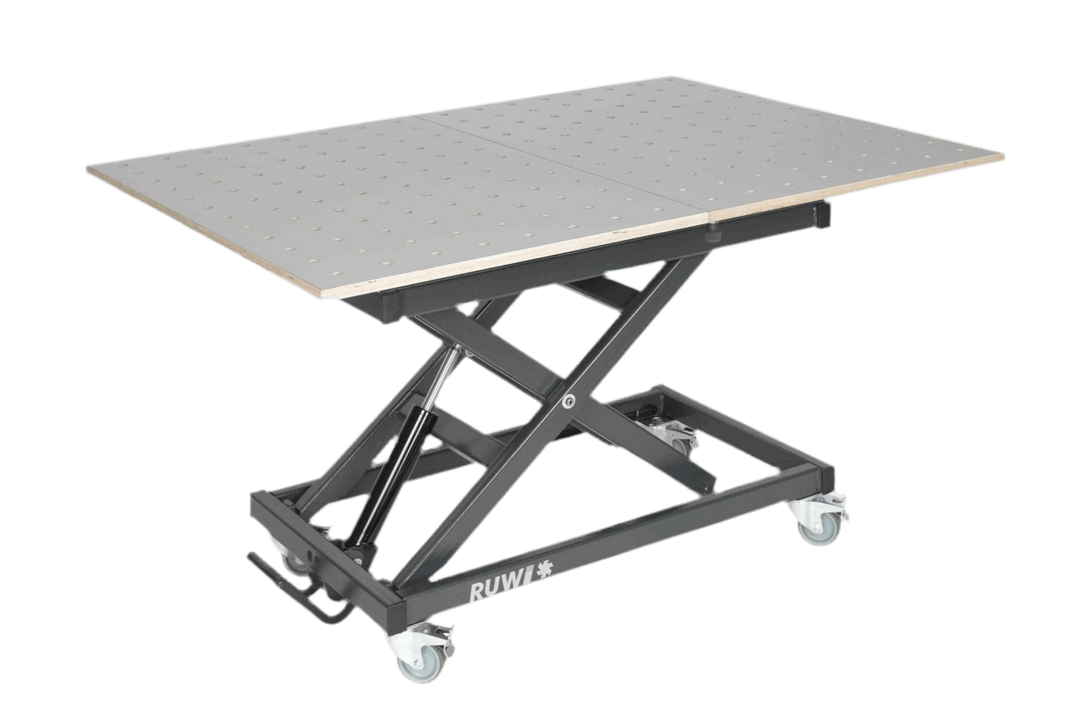
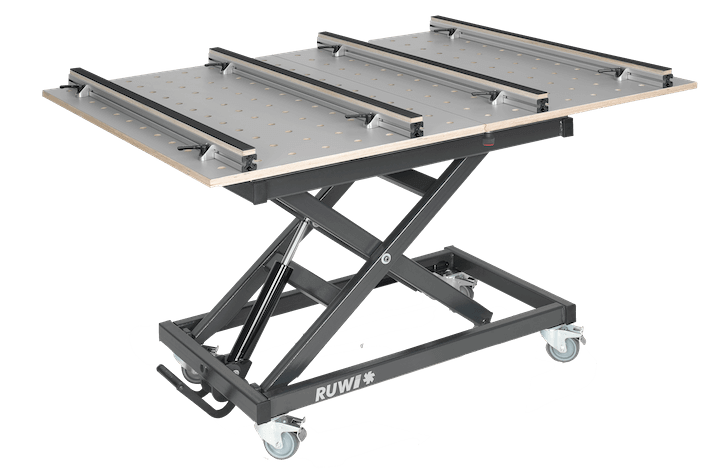

RUWI Lift Table – the height-adjustable workbench for the workshop
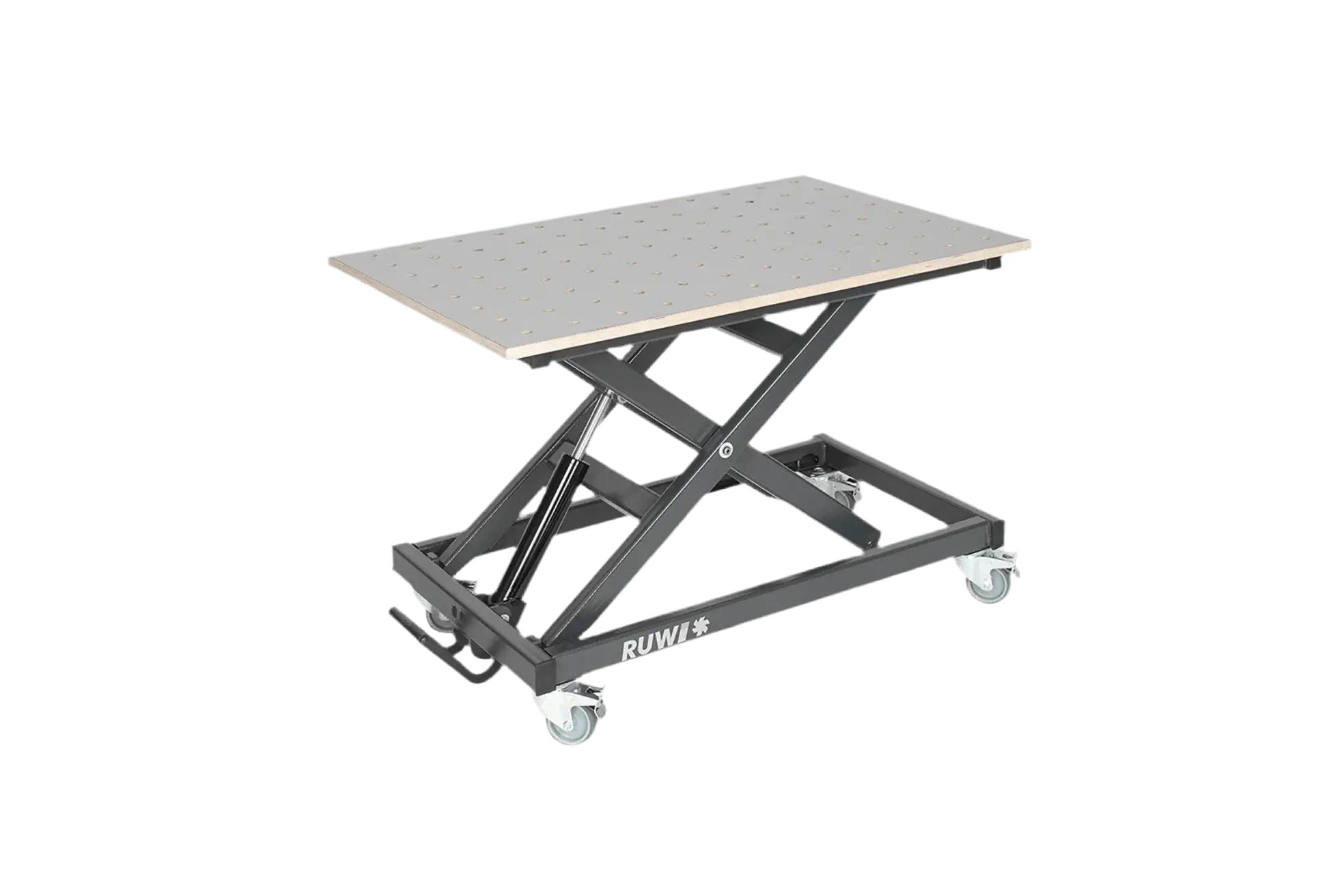
The RUWI lifting table is more than just a height-adjustable workbench: it’s a mobile assembly bench, clamping station, and transport aid all in one. Using the hydraulic foot pump—or the electric pump on battery-powered models—you can adjust the working height continuously and raise even heavy workpieces to a back-friendly height. Four lockable swivel casters let you move the table to wherever you’re working in the woodshop or workshop.
The defining feature is the 20-mm hole pattern (96 × 96 mm grid) in the HPL-coated multiplex panel: You can freely position clamps, clamping bolts, stops, and support rails on it—turning every RUWI lift table into a clamping station. The panel is scratch-resistant and easy to clean; the scissor-type construction made of rectangular steel tubes supports up to 300 or 400 kg, depending on the model.
Which lift table is right for you?
At the core are three hydraulic models with foot pumps—they cover the vast majority of workshops. In addition, there is the base frame without a top plate for custom builds:
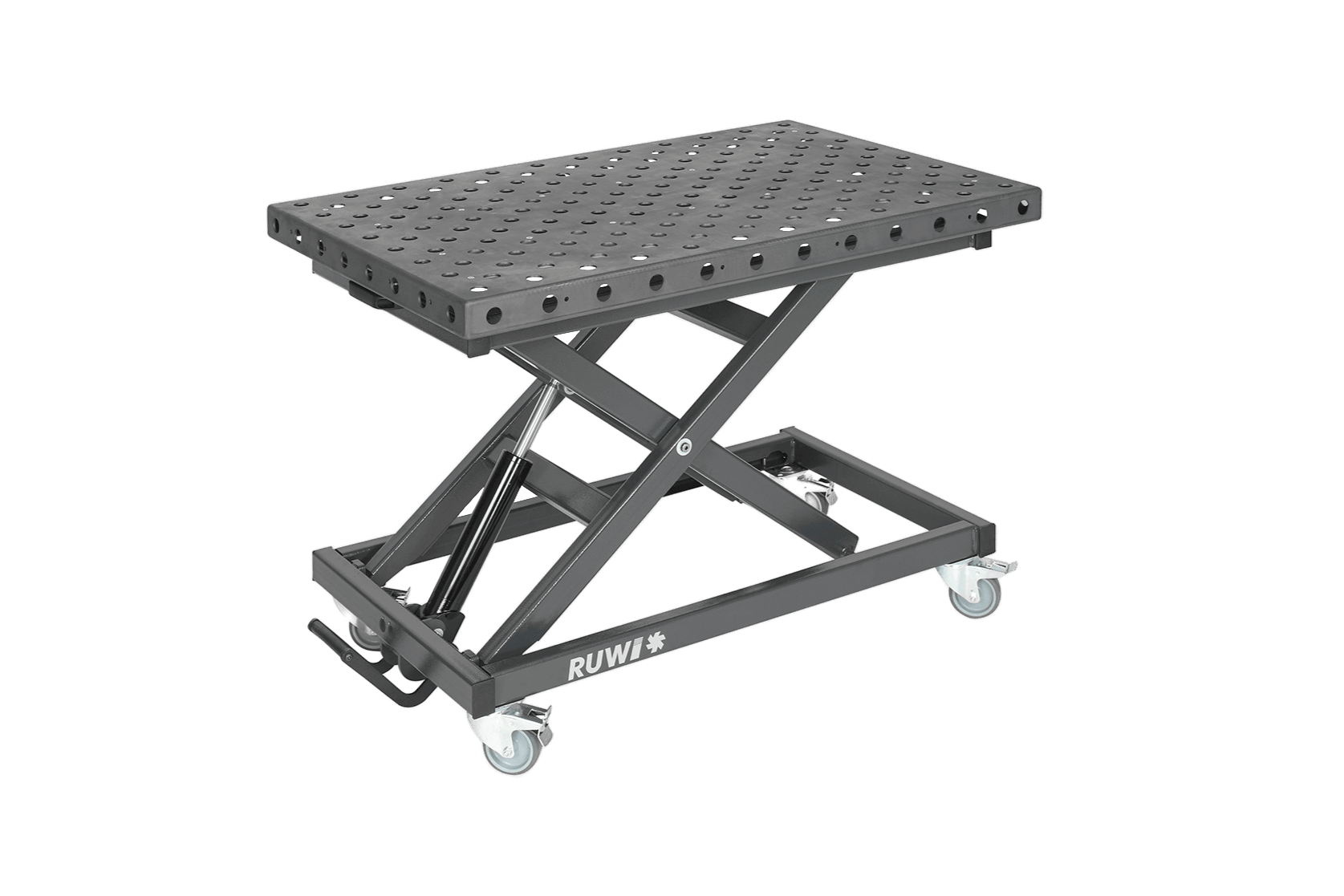
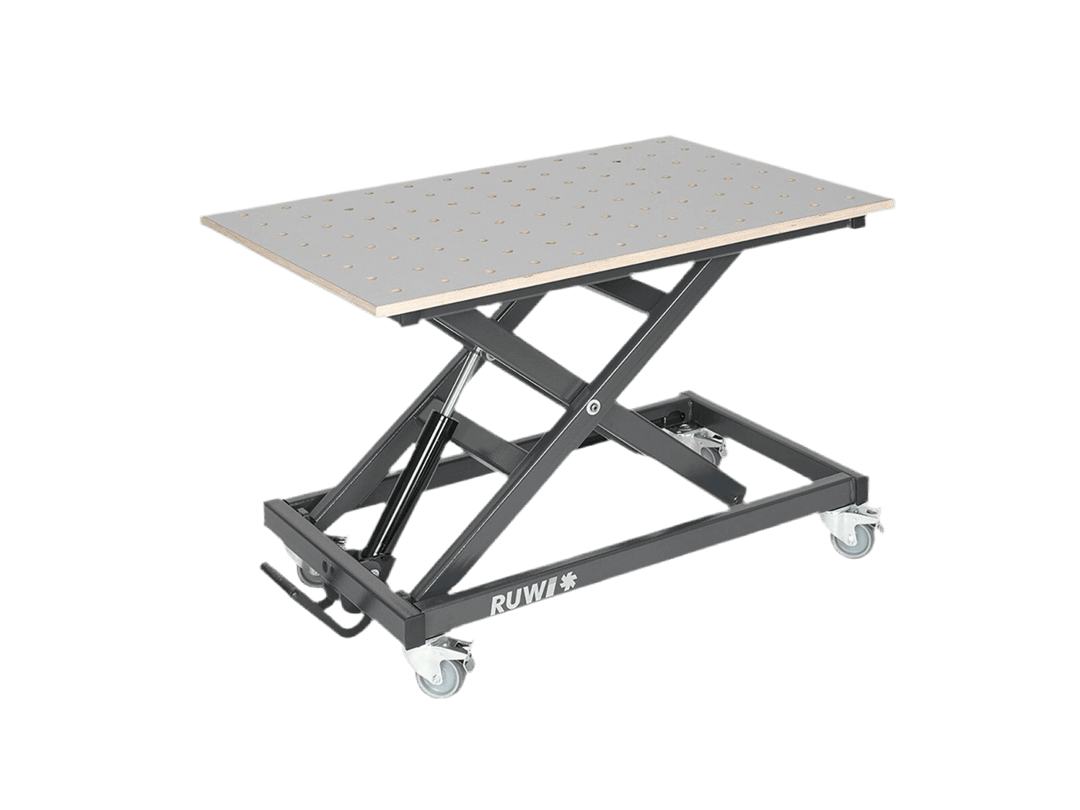
- Basic: Solid HPL perforated panel, 120 × 80 cm, without pull-out shelves – the compact clamping station for the workshop or as an additional workstation.
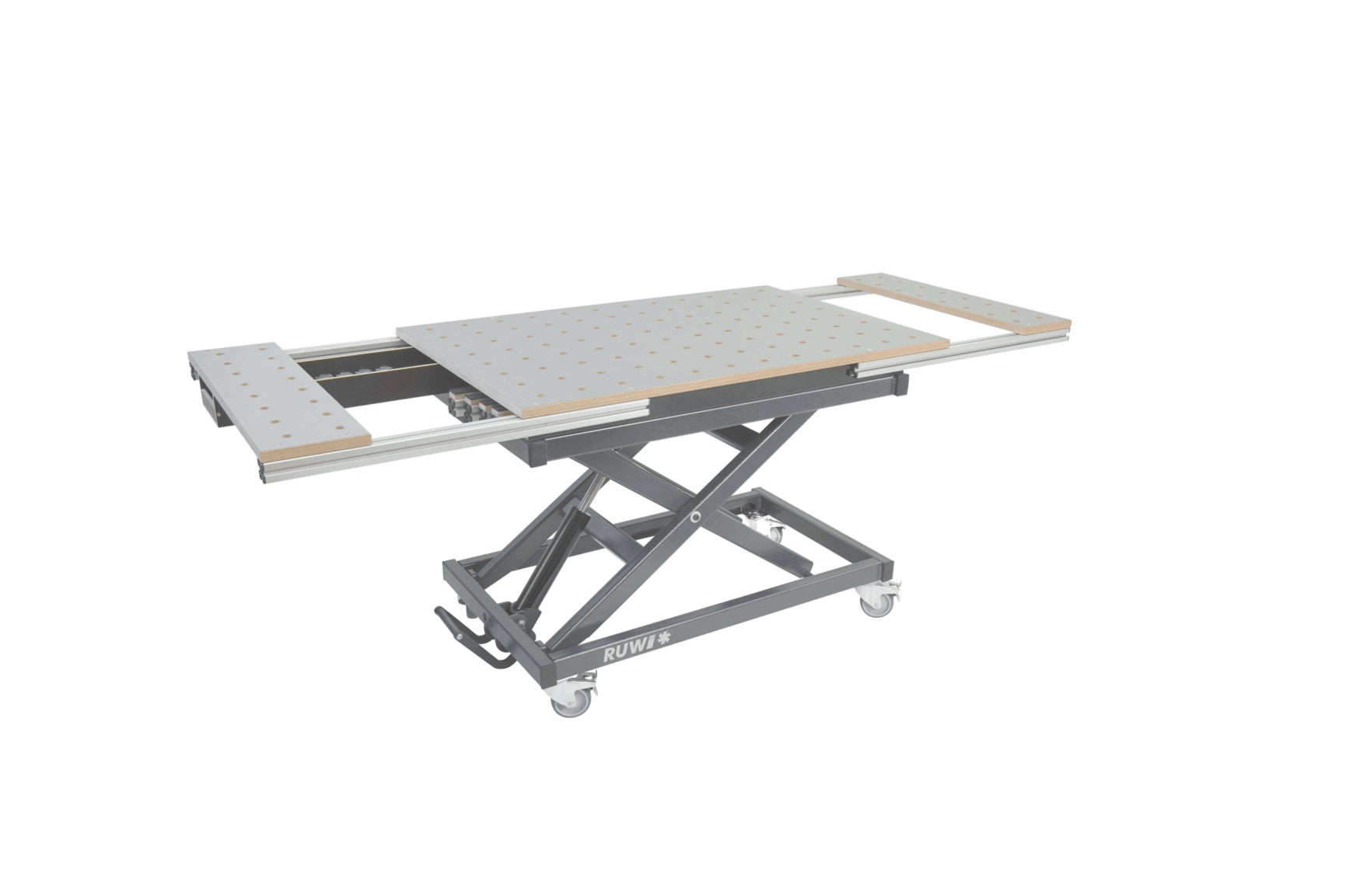
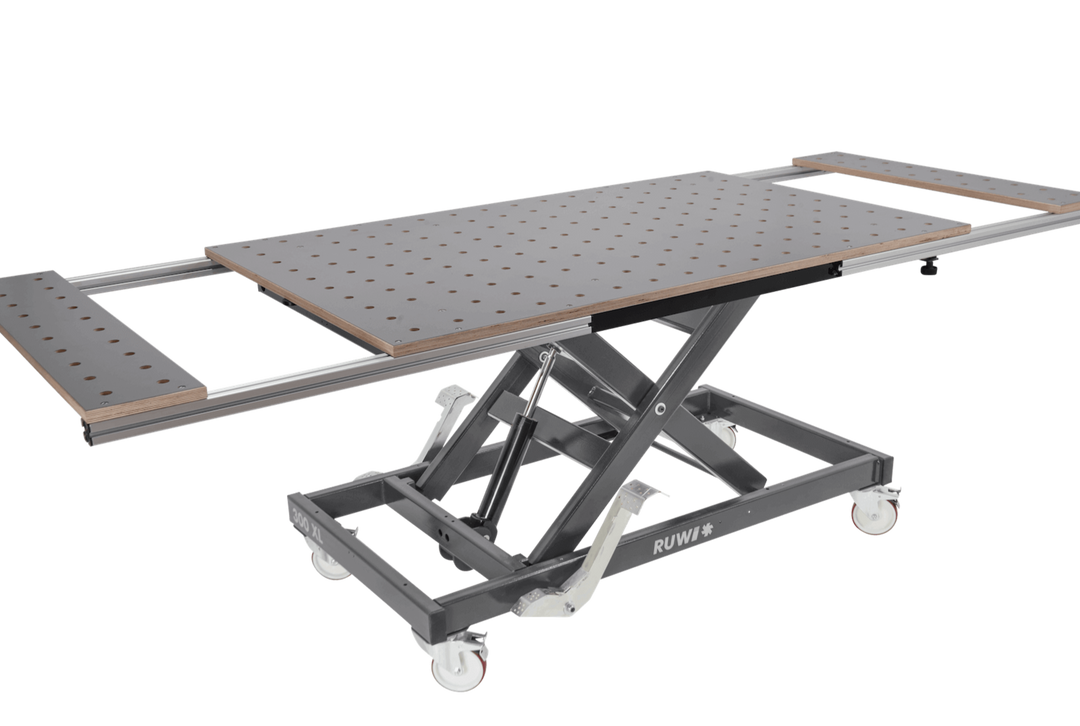
- Classic: 160 × 80 cm with two extendable sections up to 220 cm, plus a drawer and storage space—for doors, long planks, and large components.
- Premium: Base plate 120 × 80 cm, folds out to 120 × 160 cm in seconds thanks to a swivel mechanism—compact when you need to save space, spacious when it counts.
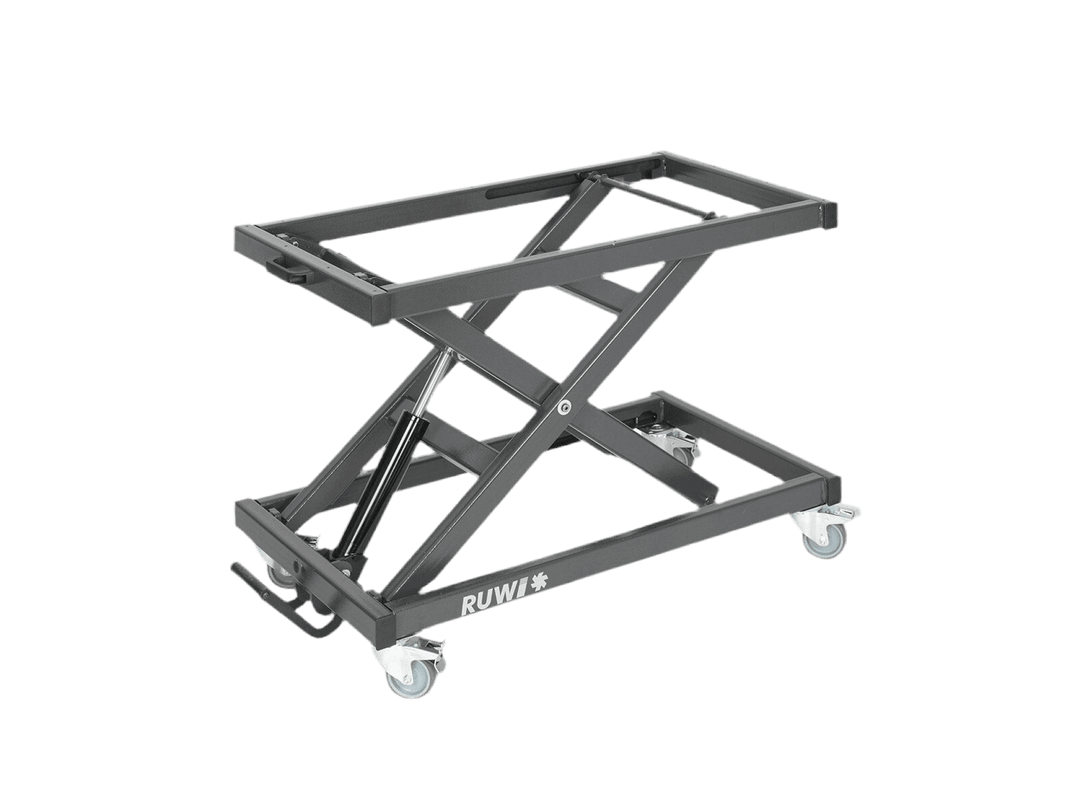
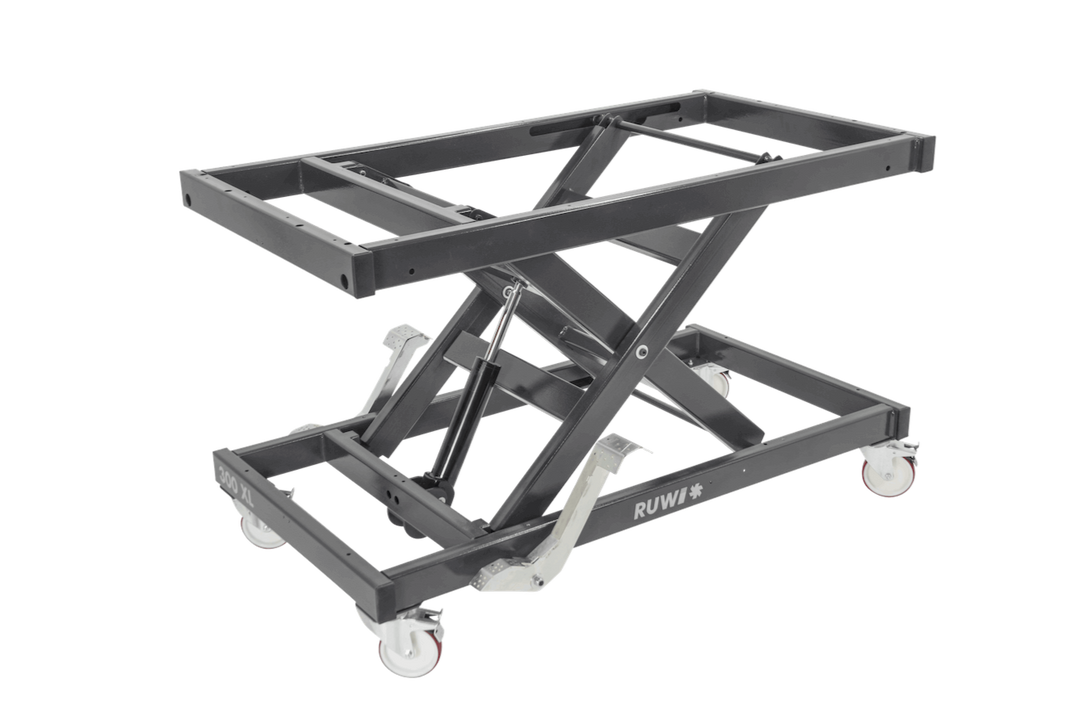
- Base: complete scissor mechanism with hydraulics and casters, without a tabletop—the foundation for your own tabletop or a machine mount.
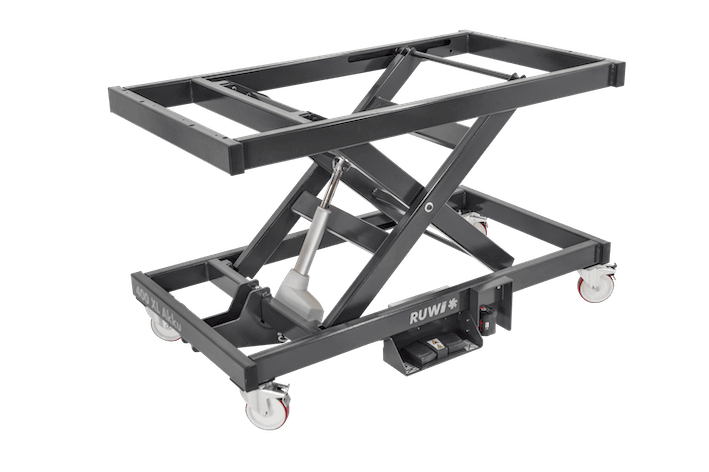
Do you need significantly more space or electric height adjustment? The Classic and base frame are also available in an XL size (200 × 100 cm) and as a 400-XL battery-powered model with a 400 kg load capacity and a foot switch instead of a pump—all versions are listed in the comparison table below.
Size, load capacity, drive system – how to choose your model
Three questions will reliably guide you to the right table:
How big does the work surface need to be?
For individual parts, cabinet sections, and assembly in one go, 120 × 80 cm is sufficient—that’s the Basic and the folded-up Premium. As soon as doors, stair stringers, or long solid wood planks come into play, you’ll want the extendable surface of the Classic: 160 × 80 cm, extendable to 220 cm if needed. Only when you regularly need to work with panels over two meters long or multiple workpieces at once does the XL format with 200 × 100 cm (extended to 270 cm) make sense. And for those who usually work in a compact space but occasionally need a lot of surface area, the Premium offers the most flexibility—its base plate measures 120 × 80 cm and folds out to 120 × 160 cm in seconds via a swivel mechanism.
How much weight capacity do you need?
The 300-kg model covers virtually all woodworking applications—including heavy cabinet bodies, laminated wood panels, and solid wood. Opt for the 400-kg models if you regularly have machinery, engineered stone, natural stone, or particularly heavy assemblies on the table. If in doubt, the 300-kg model is more than sufficient for most woodworking shops.
Foot pump or rechargeable battery?
The hydraulic foot pump operates without electricity, is durable, and is more affordable to purchase—making it the right choice for the vast majority of workshops, which is why most lift tables come equipped with it. The electric drive adjusts the height hands-free and more quickly via a foot switch, but it relies on a charged CAS battery. One thing you should know beforehand: The electric drive is only available as the 400-XL model. If you want electric adjustment, you’re also opting for the large platform and 400 kg load capacity.
In a nutshell:
| Your typical work | Compatible model |
|---|---|
| Parts, assembly, compact workshop | Basic |
| Doors, stair stringers, long planks, gluing | Classic |
| Sometimes compact, sometimes covering a large area quickly | Premium |
| Custom plate or machine mount | Underframe |
| Very large slabs or particularly heavy loads | XL and 400 battery models |
A Comparison of the Models
| Model | Work surface | Load capacity | Working height | Height adjustment |
|---|---|---|---|---|
| Base 300 | 110 × 64 cm (without top) | 300 kg | 43–103 cm | Hydraulic foot pump |
| Base Frame 300 XL | 144 × 77 cm (without top) | 300 kg | 44.5–104 cm | Hydraulic foot pump |
| 400 XL Battery Base | 144 × 77 cm (without top) | 400 kg | 69–103.5 cm | Electric / Battery-powered |
| Basic 300 | 120 × 80 cm | 300 kg | 45–105 cm | Hydraulic foot pump |
| Classic 300 | 160 × 80 cm, extended 220 × 80 | 300 kg | 53–113 cm | Hydraulic foot pump |
| Classic 300 XL | 200 × 100 cm, extended 270 × 100 | 300 kg | 47–106.5 cm | Hydraulic foot pump |
| Classic 400 XL Battery | 200 × 100 cm, extended 270 × 100 | 400 kg | 71.5–106 cm | Electric / Battery-powered |
| Premium 300 | 120 × 80 cm, unfolded 120 × 160 | 300 kg | 57–117 cm | Hydraulic foot pump |
All panels feature a 20-mm hole pattern with a grid size of 96 × 96 mm.
What else you'll need
To avoid any surprises after your purchase—here’s a breakdown of what’s included separately and what you can skip.
The 400-XL cordless models do not come with a battery or charger. They are compatible with the 18-V CAS platform, which is used by Metabo, Mafell, and Lamello, among others—if you already have such batteries in use, you can start using them right away. Otherwise, the appropriate CAS battery and the ASC 55 charger are included.
Clamps, support rails, and clamping brackets are not included with the Basic, Classic, and some Premium models—you can add them as needed. If you want to start clamping right away, go with the Premium as a Premium Set (with four support rails) or as a Clamping Technology Package (which includes two additional vertical clamps, two horizontal clamps, and eight clamping brackets).
Two ways to get your table: fully assembled or assemble it yourself
You don't necessarily have to buy the finished table—there are two ways to achieve your goal:
The Complete Table. The Basic, Classic, and Premium models come as a ready-to-use set consisting of a base frame and a matching tabletop. This is the quickest option if you know what size you need.
Base frame plus tabletop. You start with the base frame and choose the tabletop separately—often the more affordable option. The same base supports all standard tabletops: for example, you can start with a fixed perforated tabletop and later upgrade to the extendable Classic tabletop or the fold-out swivel tabletop without changing the base frame. You can also mount your own tabletop or a machine mount on the same base frame—the solution for special requirements that a standard table doesn’t cover.
Overview of table tops – all designed for the standard base frame, with HPL laminate on both sides:
| table top | Work surface | 20 mm diameter holes | drawer | Distinctive feature |
|---|---|---|---|---|
| Basic Perforated Panel | 1,200 × 800 mm | 96 | - | Solid panel, 4 mm HPL |
| Perforated panel with drawer | 1,200 × 800 mm | 96 | yes | solid panel with storage space |
| Classic | 1,600 × 800 mm, extendable to 2,200 × 800 | 128 | yes | two extendable extensions |
| Swivel plate | 1,200 × 800 mm, folds out to 1,600 × 1,200 | 96 / 192 | - | fold-out second panel |
| Swivel plate with drawer | 1,200 × 800 mm, folds out to 1,600 × 1,200 | 96 / 192 | yes | fold-out, removable drawer |
For the XL sizes (200 × 100 cm), matching slabs are available on the XL base as ready-to-use Classic XL models.
The lift table as a system
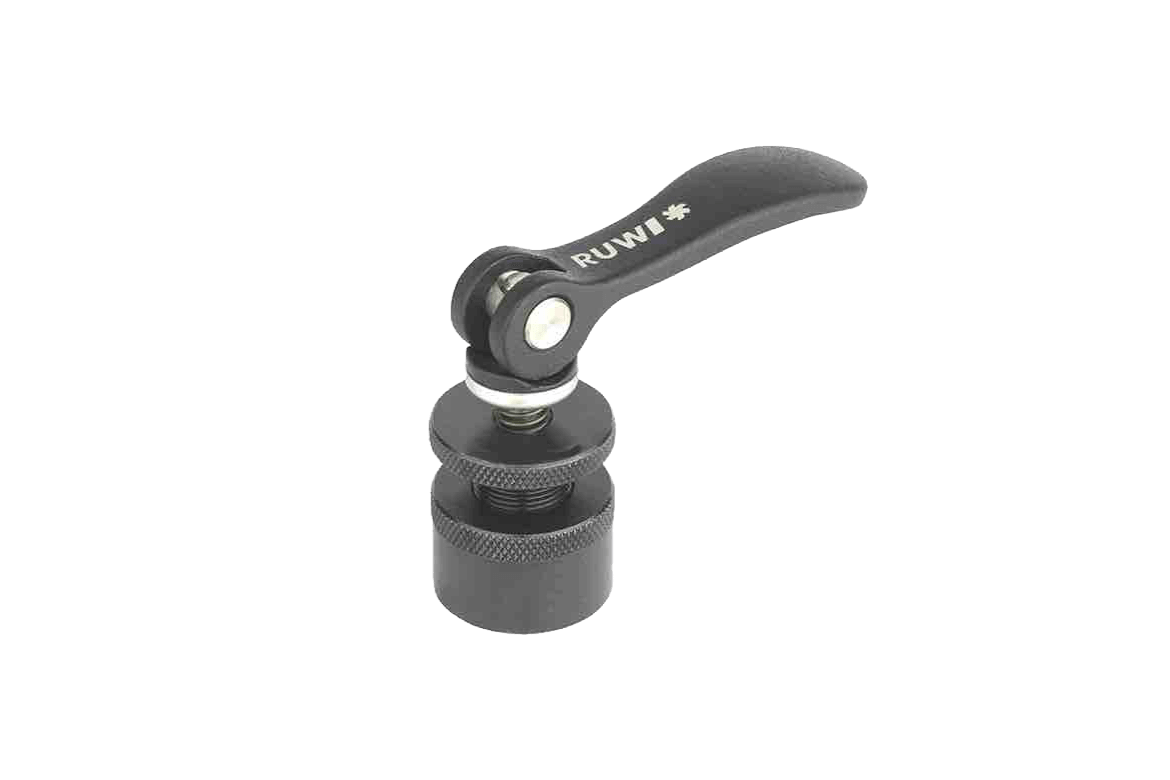
The 20-mm hole pattern isn’t just a clamping surface—it’s the common interface for an entire system. Vertical and horizontal clamps, support rails, clamping brackets, and bench hooks all fit into the same 20-mm diameter holes—once purchased, these accessories fit every RUWI lift table and any other table with a 20-mm hole pattern. The table tops are interchangeable, and drawers, the organization board, and the tool tray expand storage space without requiring any modifications. You can find everything you need in the lifting table accessories section.
Beyond the table, RUWI workshop and shelving carts match the lift tables in design and height: materials and tools are within reach at the same working height, and the next step is just a quick reach away. In this way, a single table gradually evolves into a well-designed workspace.
Features at a Glance
You can adjust the lifting mechanism smoothly and effortlessly—using the hydraulic foot pump manufactured in Germany or, on the 400-XL models, electrically via a rechargeable battery. A safety valve lowers the platform in a controlled manner in the event of overload, rather than allowing it to bottom out. The multiplex panel, coated with HPL on both sides and featuring a 20-mm hole pattern, accommodates clamping and fixing accessories. Four solid rubber swivel casters with brakes ensure quick positioning and a secure footing, while the welded scissor-type construction made of steel tubing provides stability during continuous use.

Where the lift table is used
In carpentry, joinery, and interior finishing, it serves as an assembly, gluing, and clamping station; in plastics processing, for trimming, sanding, and chamfering; in industry and trade, as an ergonomic assembly station and flexible transport aid; and in training workshops, as a back-friendly workstation adjustable to any body size. Because the height can be adjusted to the workpiece rather than the other way around, you protect your back and joints and save yourself the trouble of reconfiguring multiple tables.

FAQs
A scissor lift table raises and lowers heavy loads using two crossed legs connected at a central pivot joint: one side is fixed to the frame and platform, while the other runs on slide bearings. On the RUWI lift table, height adjustment is infinitely variable via a hydraulic foot pump manufactured in Germany; on the 400-XL models, it is electric and battery-powered.
Frequently used for assembling and gluing mass-produced parts, as an ergonomic workbench extension, as a height-adjustable stacking cart, for the internal transport of materials and workpieces, and as a flexible extension of the work surface on planing benches.
Yes. In Europe, the 20-mm hole pattern has become the standard; Festool MFT and Sauter Variobench also use it. RUWI HPL panels feature precisely milled 20-mm holes in a 96 × 96 mm grid—RUWI accessories with 20-mm clamping bolts are therefore compatible with other 20-mm hole grid tables and vice versa.
It comes largely pre-assembled. It takes just a few simple steps to prepare it for space-saving, secure shipping; assembly instructions are included.
Call us at +49 7402 8414 or send us an email—we'll help you choose the right model.
Yes. Several partners showcase the lift tables in their showrooms; you can also find application videos on our YouTube channel.