





lifting table for the workshop
Lifting Table for the Workshop: The Workpiece Comes to Your Hands
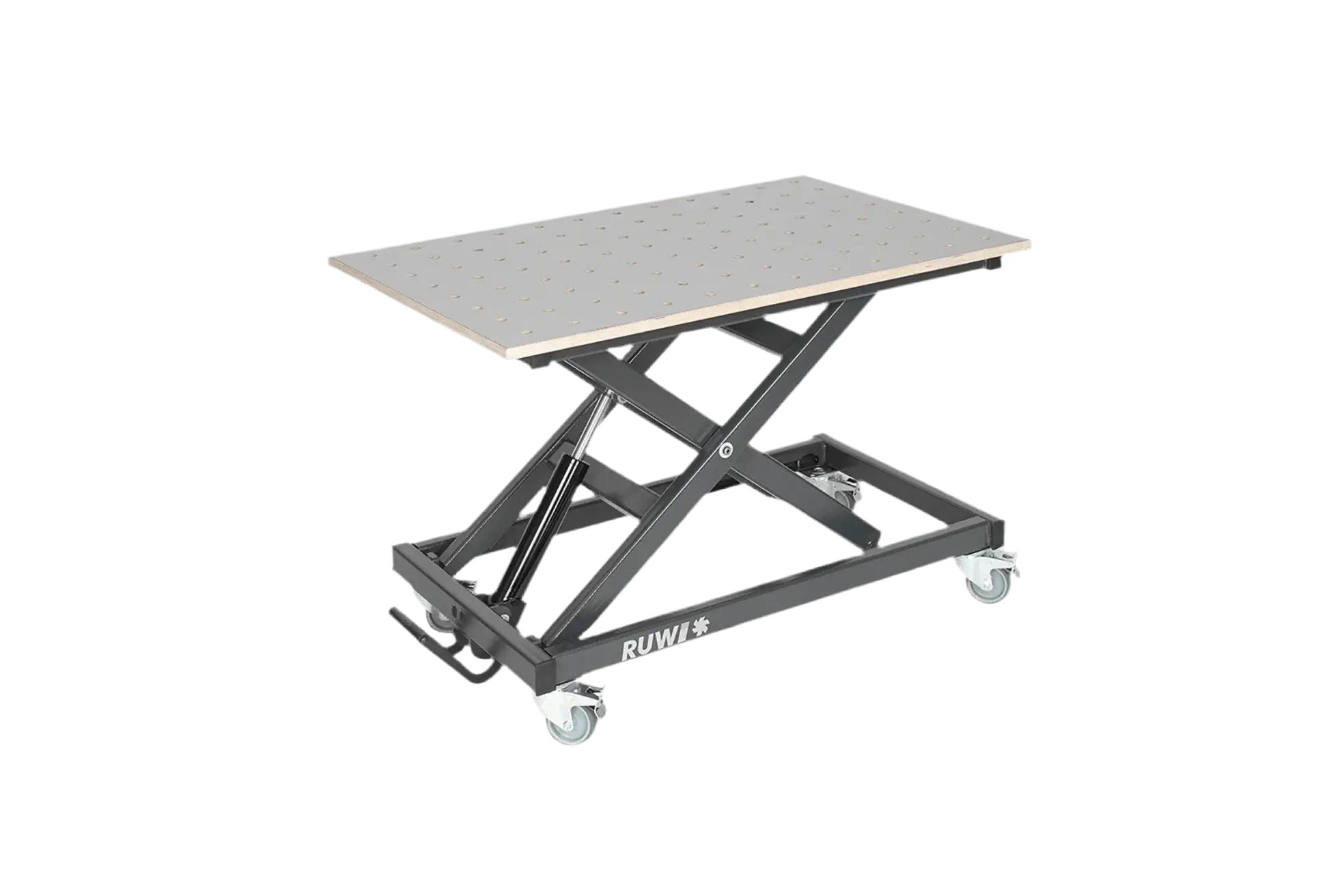
You load the workpiece continuously onto working height, clamp it onto the Ø 20 mm hole grid, and move it to where you need it.
Which model is right for you?Direct from the manufacturer · Free shipping · Family-owned business since 2000


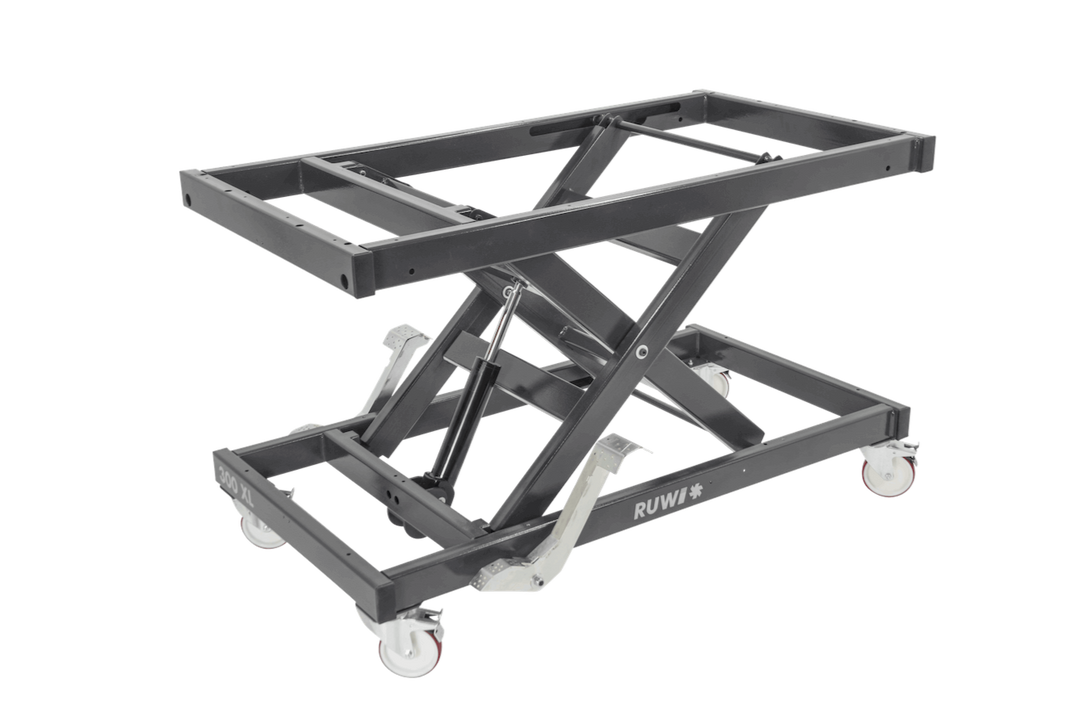
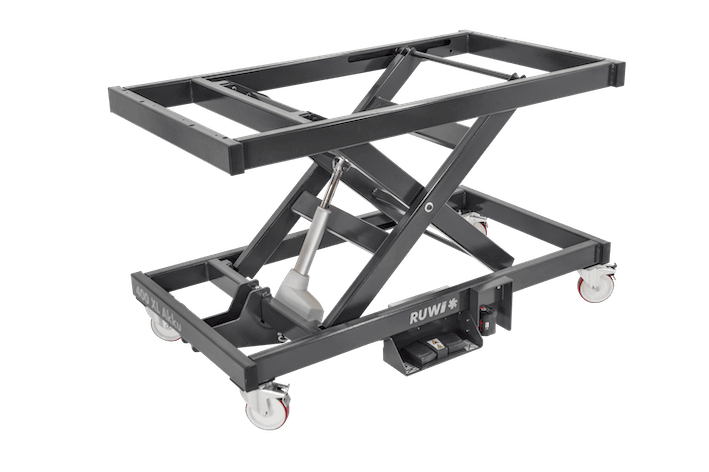
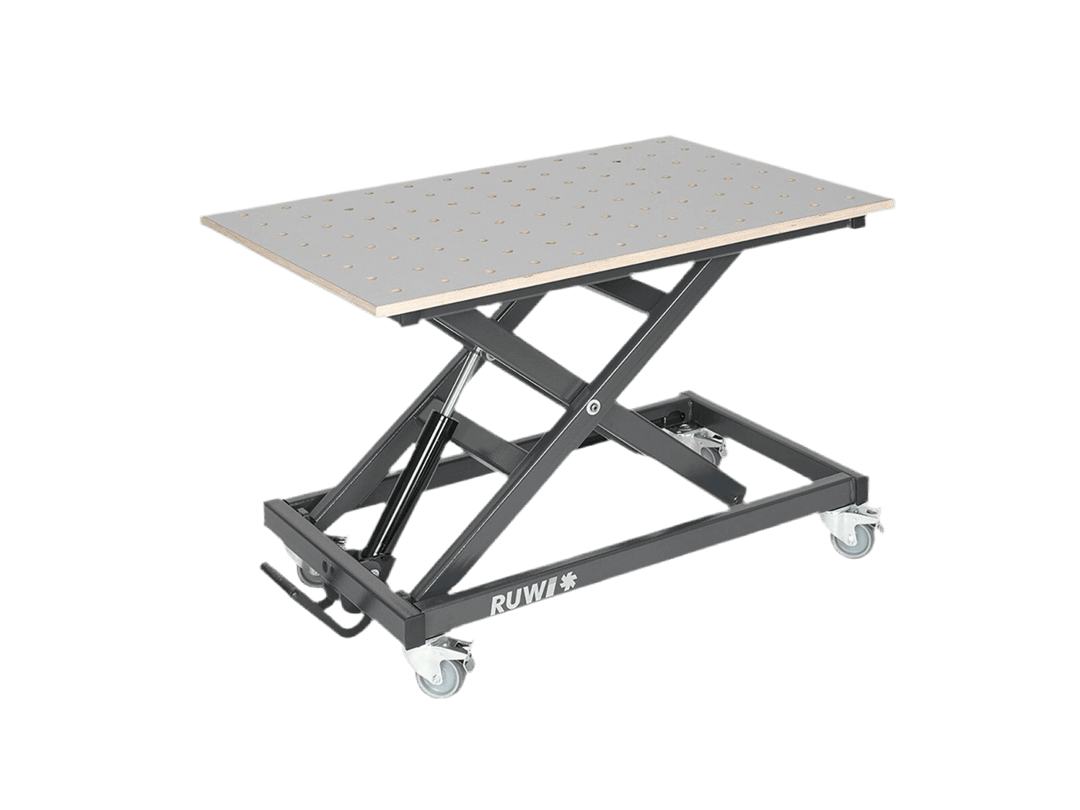

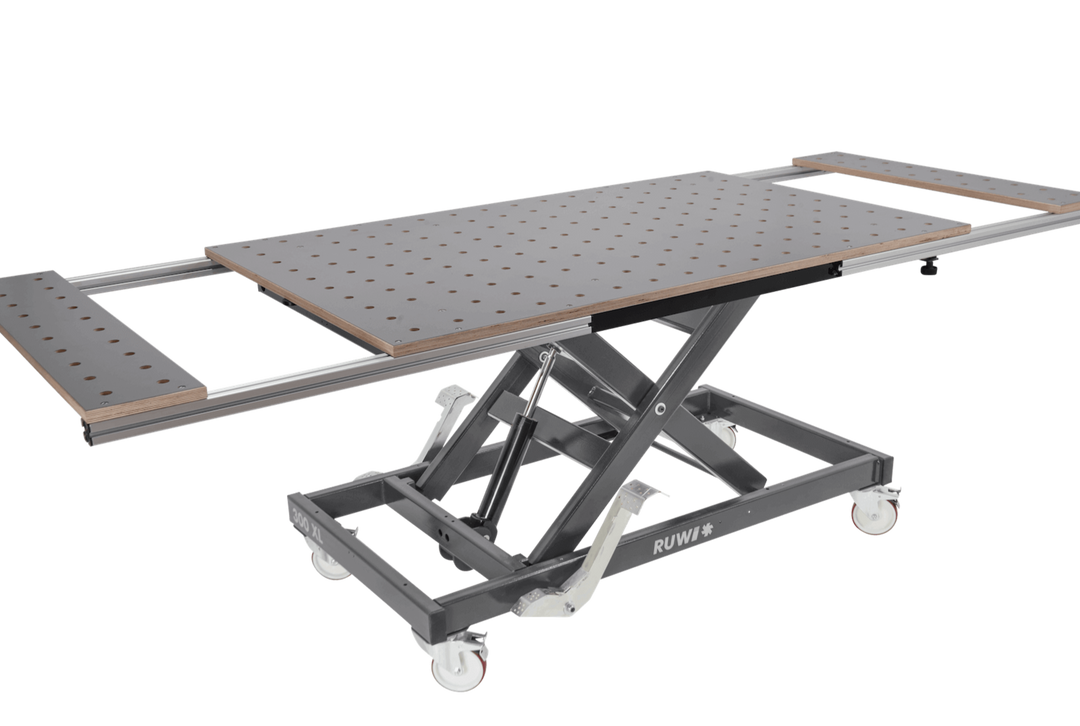

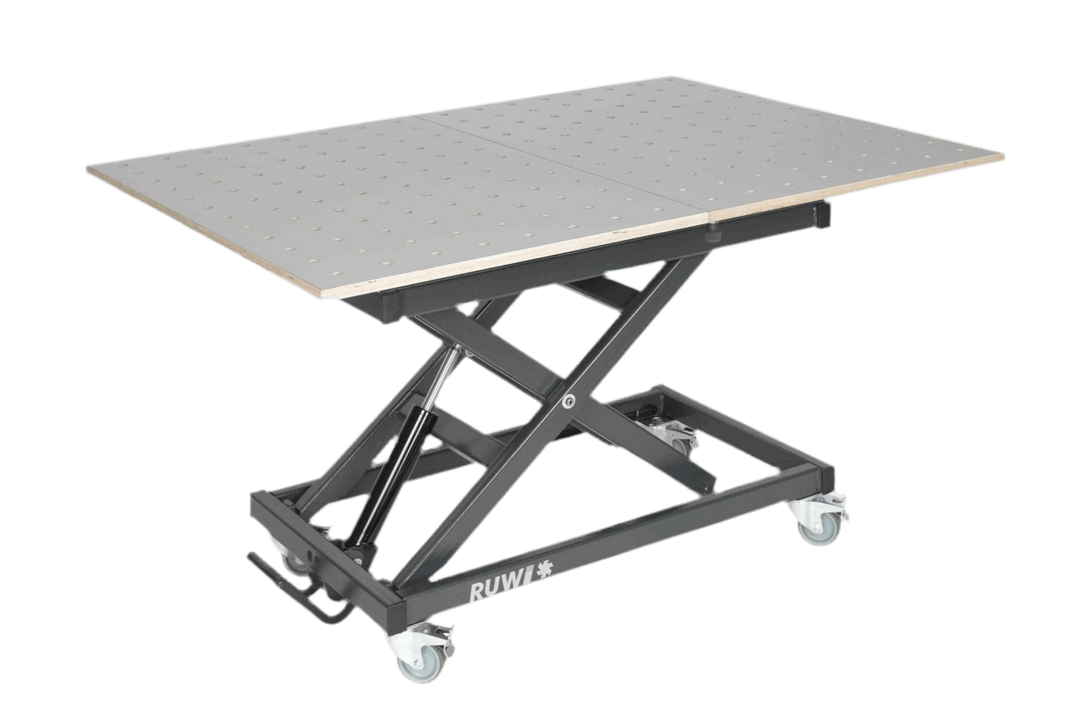
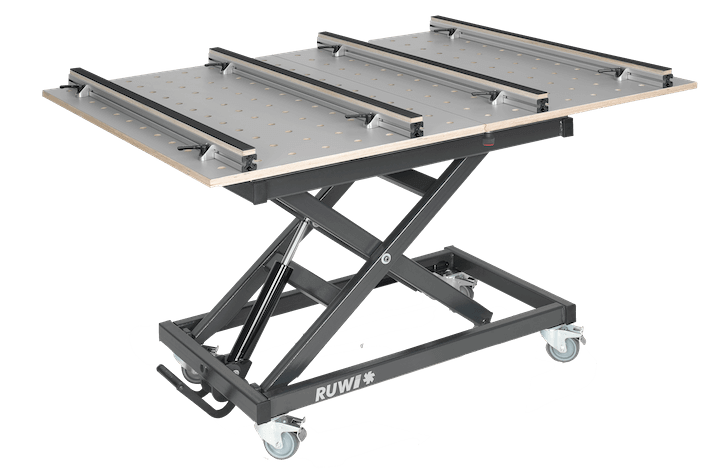


Decision-Making Guide
Prefer to compare them yourself? The four models
Choose a table that suits your work, or build your own using base frame and a tabletop.
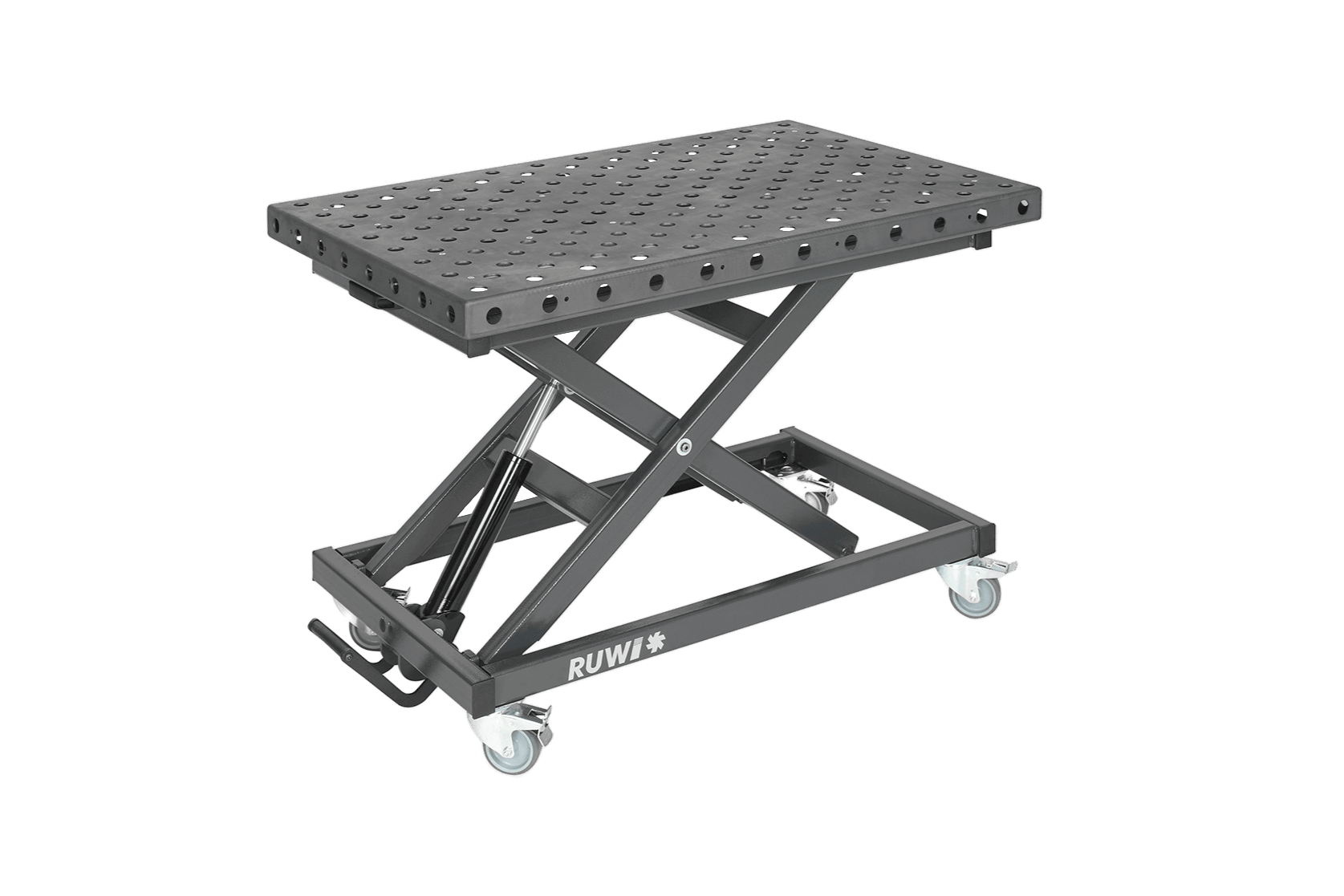
Basic
120 × 80 cm, rigid · 300 kg · foot pump
If you're working in a compact space or need a second workstation.
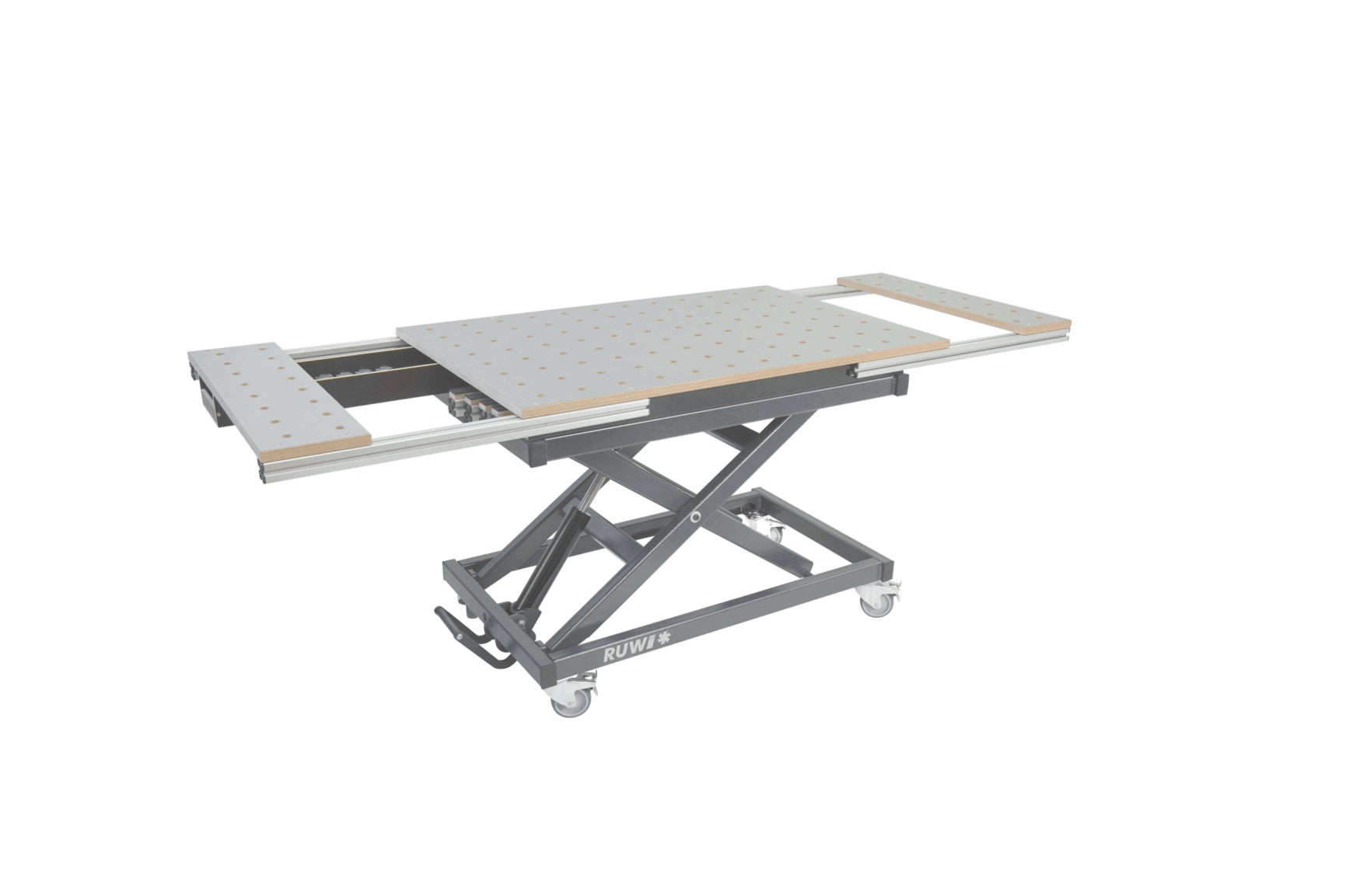
Classic
160 × 80 cm, extends to 220 cm · 300 kg · foot pump
When you're working on doors, door frames, and long planks.
Premium
120 × 80 cm, folds out to 120 × 160 cm · 300 kg · foot pump
For when you need a little space one time and a lot the next.
Classic 400 XL
200 × 100 cm, extends to 270 cm · 400 kg · electric
If you do heavy lifting every day or need panels longer than two meters.
For most workshops, the Classic is the right choice. In addition to the pull-out feature, it offers another advantage: the side clamping profiles are designed to hold Bessey GTR clamps directly.
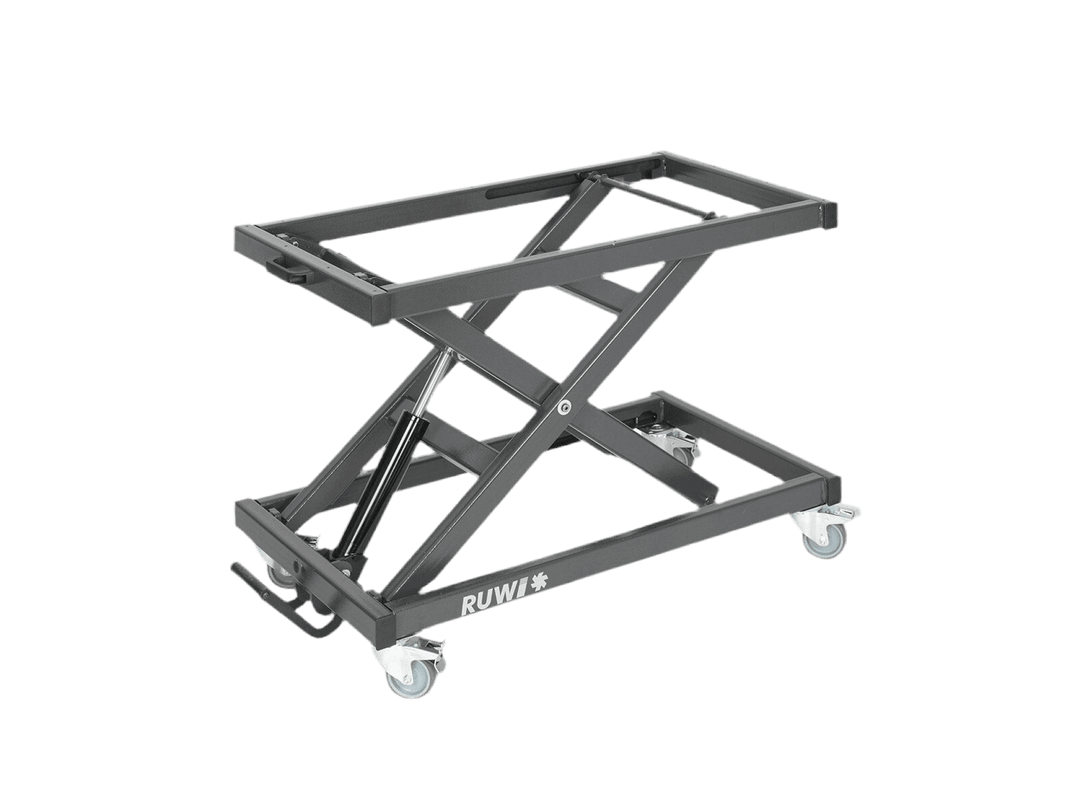
Prefer to customize it yourself? Start with the base frame starting at €1,311.99 (net) and choose your tabletop: fixed, extendable, or fold-out. The same base supports all tabletops.
"Fast delivery, great product (RUWI lifting table Basic). Set it up quickly and started using it right away. I'd definitely buy from them again!"
Holger J, verified buyer
The RUWI hole grid
Tensioned with a single turn, from above
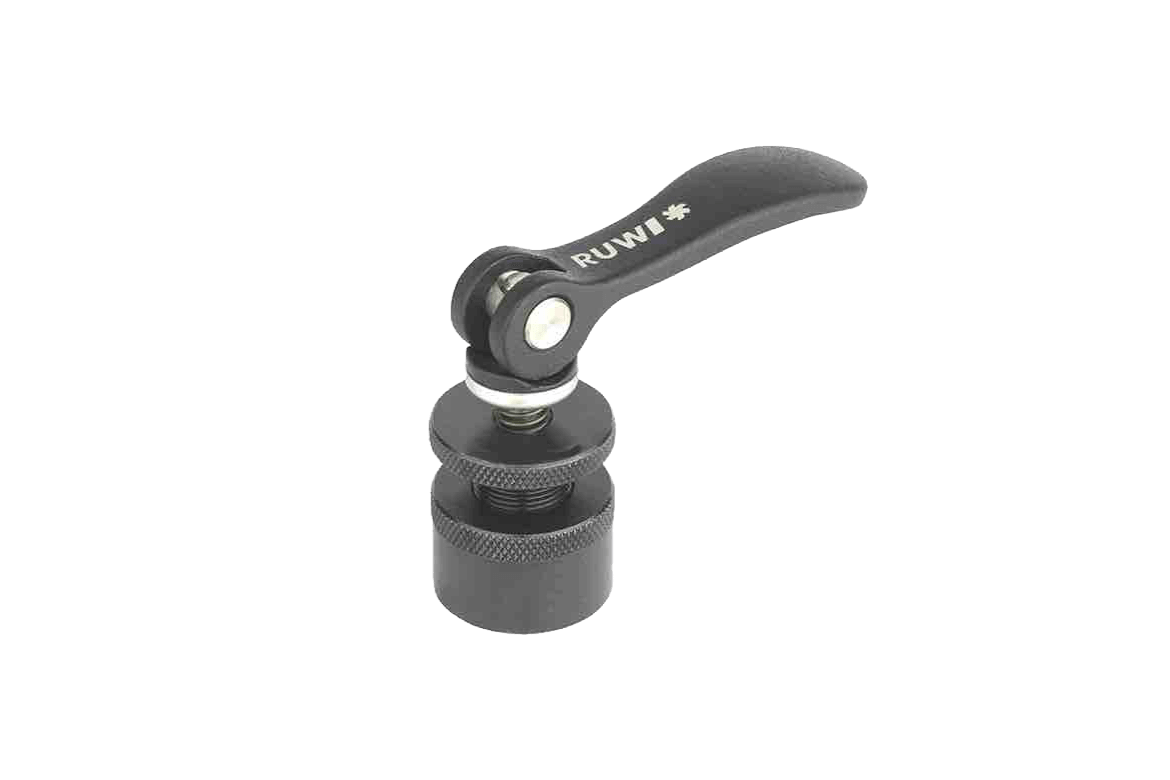
Every perforated panel has 20-mm-diameter holes. The difference lies in the bolt: A plug-in bolt fits as tightly as the hole allows. The RUWI clamping bolt is tensioned. A single turn from above—either on the clamping lever without tools or on the socket screw SW 6—and the bolt components lock into the hole. The finely ribbed surface then fits into the panel without any play.
Insert the bolts into a 20-mm-diameter hole at any position within the 96-mm grid.
A twist from above: The bolt components lock into place in the hole.
Clamp, secure, assemble. The bolt fits like a machine component, not like a snap-fit part.
This changes the way you work on the table: You don’t reach under the table or tighten anything from below. On its own, the bolt serves as a reference point—that’s how we use it in our workshop. You can secure and align workpieces at virtually any point on the table, from the cabinet body to the miter rail. To clamping bolt
"The d=20mm bolts fit perfectly and are very secure."
Heinrich V., Verified Buyer · December 9, 2024

working height
It's not the height of the table that matters, but the height of your hands
Working height is the workpiece height plus the table height. A 60-cm cabinet on a fixed 90-cm bench brings your hands up to 150 cm: shoulder height instead of working height. That's why a fixed bench always matches only one specific workpiece height.
The rule of thumb for this comes from occupational safety: For assembly work, the hands should be at elbow height; for heavy-duty work, 10 to 15 cm below that; and for precision work, 10 to 15 cm above that (DGUV Information 208-053 “People and the Workplace,” 2024 edition).
That’s exactly what the stepless height adjustment does: The workpiece comes to your hands; lifting is done hydraulically instead of by hand, and the workpiece is supported by the table instead of by a second person. Depending on the model, the range extends from 43 to 117 cm. And the table adjusts to whoever is standing at it: 1.90 m in the morning, 1.65 m in the afternoon. Adjustment is hydraulic and foot-operated, so both hands stay on the workpiece; on the 400 XL, a single push of a button is all it takes.

From Real-World Experience
Place the board on the saw by itself
That moment every workshop is familiar with: The panel needs to go on the saw, and no one is around. With the lifting table, here's how it works: Position the table next to the stack, lower it to stack height, and slide the panel onto it instead of lifting it. Lock the casters, move it over to the saw, pump it up to the height of your machine table, and slide it over. You didn't lift a thing. And at the end of the job, just reverse the process: Lower the table to loading dock height and slide the panel into the van.
And when there’s no panel waiting to be worked on: three stations, one storage spot. Measuring 120 × 80 cm, the table serves as an assembly bench, clamping station, and transport cart. When you need the space, just roll it up against the wall.
When it isn't the answer, we also say: For hand planing and chiseling, a fixed workbench is still the best choice; a table on casters simply can't match its rigidity. And anyone who moves panels on a continuous basis is better off with a vacuum lifter.

The System
The system grows with your workshop
The base frame and the tabletop are separate: The same base supports the fixed, extendable, and fold-out tabletops. Changing the tabletop is rare in practice, but it's possible: If you start with the Basic model, you're not locked in. And you work just as you always have, only at your own height: You clamp it in place as usual, and your 20-mm accessories remain in use.
In addition, the range of related products is expanding: Workpiece supports for protruding ends, support rails, clamps, and stops can be found in thelifting table accessories section. The hydraulic system is repairable, and replacement parts are always in stock.
The 400-XL models run on CAS batteries (Metabo, Mafell, Lamello, and others). The battery and charger are not included: If you use CAS tools, you already have both on your shelf.
Investment
How much does the second man cost?
The most common hidden cost: A second employee is often needed to turn, position, and hold heavy parts. Use your own figures to calculate how much this costs per year. The lifting table can position the workpiece at the correct height on its own and hold it there.
Second employee on a fixed-term contract: €6,300 per year
Sample calculation based on open assumptions; no measurements were taken. The default value is a deliberately conservative workshop billing rate. Your number is what matters: Enter your own rate.
The second area of concern is the back: musculoskeletal disorders account for 30.9 percent of all days lost to absence in the skilled trades (IKK classic, Absenteeism Analysis 2024). A height-adjustable table does not prevent these conditions, but it reduces the strain at the source.
For tax purposes, the table is an asset that you can depreciate. Run some calculations using a few inputs: Go to the depreciation calculator.
Funding, to be honest: There's generally no subsidy for healthy work practices, and the BGHM doesn't provide a purchase incentive. If an employee has a health-related disability, the table may be subsidized as a technical work aid—depending on the case—through pension insurance, the Employment Agency, accident insurance, or the Inclusion Office. The Employment Agency specifically cites height-adjustable tables as an example of such assistive devices. Important: Submit your application before you place your order.
Not a sales pitch, but a workshop consultation
Talk to a master cabinetmaker about your lifting table
We'll figure out which model is right for your workshop in ten minutes. Not by looking at spec sheets, but by focusing on your work: what kinds of workpieces, what kind of workspace, and what kind of drive system. Reiner Ruggaber is a master cabinetmaker himself and takes the time to help you. We prepare written quotes for schools, funding agencies, and competitive bids—we receive requests for these on a regular basis.
Frequently Asked Questions About the lifting table
What is a scissor lift table?
A scissor lift table is a height-adjustable work table whose platform is raised and lowered by two crossed legs connected in a scissor-like configuration. In the workshop, it serves as a mobile assembly, clamping, and transport station; in the trades, it is also known as an assembly lift table: You raise the workpiece to the height that suits the task, rather than bending down to reach it. On the RUWI lifting table, the height adjustment continuously is operated via a hydraulic foot pump manufactured in Germany; on the 400-XL models, it is powered electrically by a rechargeable battery.
What kind of working height should a lifting table have?
The rule of thumb in occupational safety: For assembly work, hands should be at elbow height; for heavy-duty work, 10 to 15 cm below that; and for precision work, 10 to 15 cm above that. What matters is the height of your hands relative to the workpiece, not the table height. That’s exactly what the stepless height adjustment is for: RUWI lifting tables can be adjusted between 43 and 117 cm depending on the model, making them adaptable to any body size and any task.
What is a 20-mm hole grid?
The 20-mm hole grid is a work surface with evenly spaced 20-mm-diameter holes, arranged in a 96 × 96 mm grid at RUWI. You can insert vertical and horizontal toggle clamp, stops, clamping brackets, and bench dogs into these holes to secure workpieces at virtually any point. Because the 20-mm grid is standard in woodworking, accessories from Festool MFT, Sauter, and Bessey also fit without any modifications.
Lifting table with foot pump or electric: Which is better?
Both have their merits. The hydraulic foot pump operates without electricity, is durable, requires little maintenance, and is more affordable—making it the right choice for most workshops. The electric battery-powered drive adjusts the height hands-free via foot switch and is faster, especially when several people are working at the table or adjustments are made frequently. At RUWI, the electric drive is only available on the 400-XL model: If you want the electric version, you'll also get the large work surface and a 400 kg capacity load capacity.
Are there any used RUWI lifting tables available?
Time and again, as demonstration or trade show models: We inspect these devices after use and add them to our "Tool Treasures" section at a discount. There you'll find used devices and demonstration models directly from the manufacturer. If there's no "lifting table" listed right now, just ask.