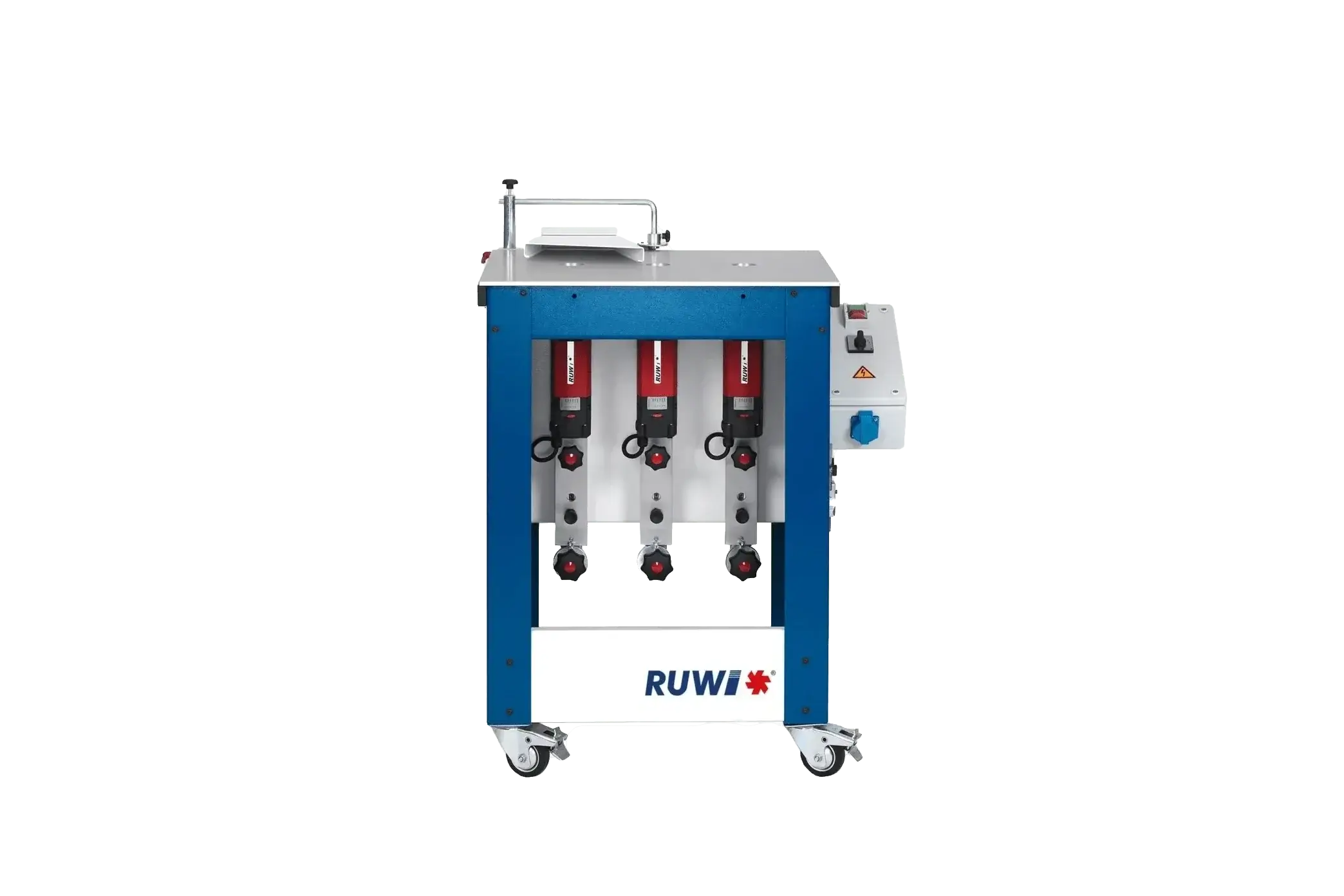
Tool changes are the biggest time-sink on any router. You rout an edge flush, then need the rounding bit, followed by the groove cutter—and each time, you have to unclamp, clamp, adjust, and test. The RUWI router table Classic solves this with a simple principle: three router motors on a single table, each with a permanently clamped tool. Finish one, move it along, and keep going.
Each of the three motors delivers 1,050 watts on the 640 × 500 mm table surface; you c continuously ly adjust the speed from 8,000 to 25,000 rpm—with soft start, inrush current limiting , and constant speed under load, designed for continuous operation. The steel spindle (Ø 22 mm) is mounted on dual bearings; the return thread keeps dust out of the bearings; you can change tools up to Ø 40 mm from the top. The dual dust extraction system above and below the tabletop (connection Ø 120 mm) is standard. GS-certified (DGUV Test), tested for wood dust, developed and manufactured in Germany.
The Classic is the best-selling RUWI router table model in the woodworking and interior finishing industries—and built to outlast generations of woodworkers. Some Classic machinesrouter tables have been in use at the same shops for over 20 years. At the Schwarzwälder woodworking shop in Königsfeld —a family-run business since 1928—there is a Classic in the workshop, used, among other things, for post-CNC finishing.
Here's how to use it
-
Running three cutters in parallel: The rounding, chamfering, and grooving cutters remain clamped and adjusted—no changeover, no readjustment, and no test milling between operations.
-
Machining edges and profiles: Furniture parts, doors, stairs, and solid wood elements run through the stop—the workpiece moves toward the tool.
-
Mass production: Edge profiles, slots , and recessed handles with no time lost between components—setup time is required only once, beforehand.
-
Supplementing the CNC: Finishing operations and special cuts that aren't cost-effective to do on the CNC are done manually in a separate area.
-
Roll them to where the milling is taking place: four castors with brakes—the 91 kg units roll into position and then come to a stop.
-
Training: GS-certified (DGUV Test) and tested for wood dust—also suitable for training workshops, vocational schools, and companies that provide on-the-job training.
Does this fit in your workshop?
The table measures 640 × 500 mm with a height of 910 mm working height. The dust extraction connection has a diameter of 120 mm for your dust extraction system; the standardcollet has a diameter of 8 mm, and additional collets are available for shanks with diameters of 6 / 6.35 / 9.5 / 10 mm. You can retrofit the 0.1-mm fine adjustment spindle by spindle (tables manufactured starting in October 2024).
If you only need one spindle, you’re better off with the RUWI router table Basic; if you want five to ten, check out the Premium. For larger shanks and tools up to Ø 55 mm, there’s the Classic Performance with 1,600-watt motors. And if you don’t want to base your decision on the spec sheet, the configurator will calculate the right model based on your requirements.
All the details
Dimensions and Mobility
Table Size: 640 × 500 mm
working height : 910 mm
net weight : 91 kg
Mobility: 4 castors with brakes
Motors and Power
Motors: 3 × 1,050 watts (230 V), manufactured in Germany
Speed: continuously 8,000 to 25,000 rpm per motor
Electronics: soft start with inrush current limiting, constant speed under load, designed for continuous operation
Milling spindle
Spindle: Steel, Ø 22 mm, double-bearing – for smooth concentric rotation
Dust protection: Return thread, keeps dust out of the bearings
tool diameter : up to Ø 40 mm
Tool change: from above
collet : Ø 8 mm (alternatively Ø 6 / 6.35 / 9.5 / 10 mm)
Dust Extraction
Extraction: dual, above and below the tabletop
Connection: Ø 120 mm
Safety and Quality
Origin: developed and manufactured in Germany
Certification: GS-certified (DGUV Test), tested for wood dust