





October 15 through December 31, 2026
Every new RUWI router table comes with the matching guide rail at no extra charge—in the store, over the phone, and through our partners. Check out our fall promotion
Underfloor Milling Machines · “Made in Germany” from Fluorn-Winzeln
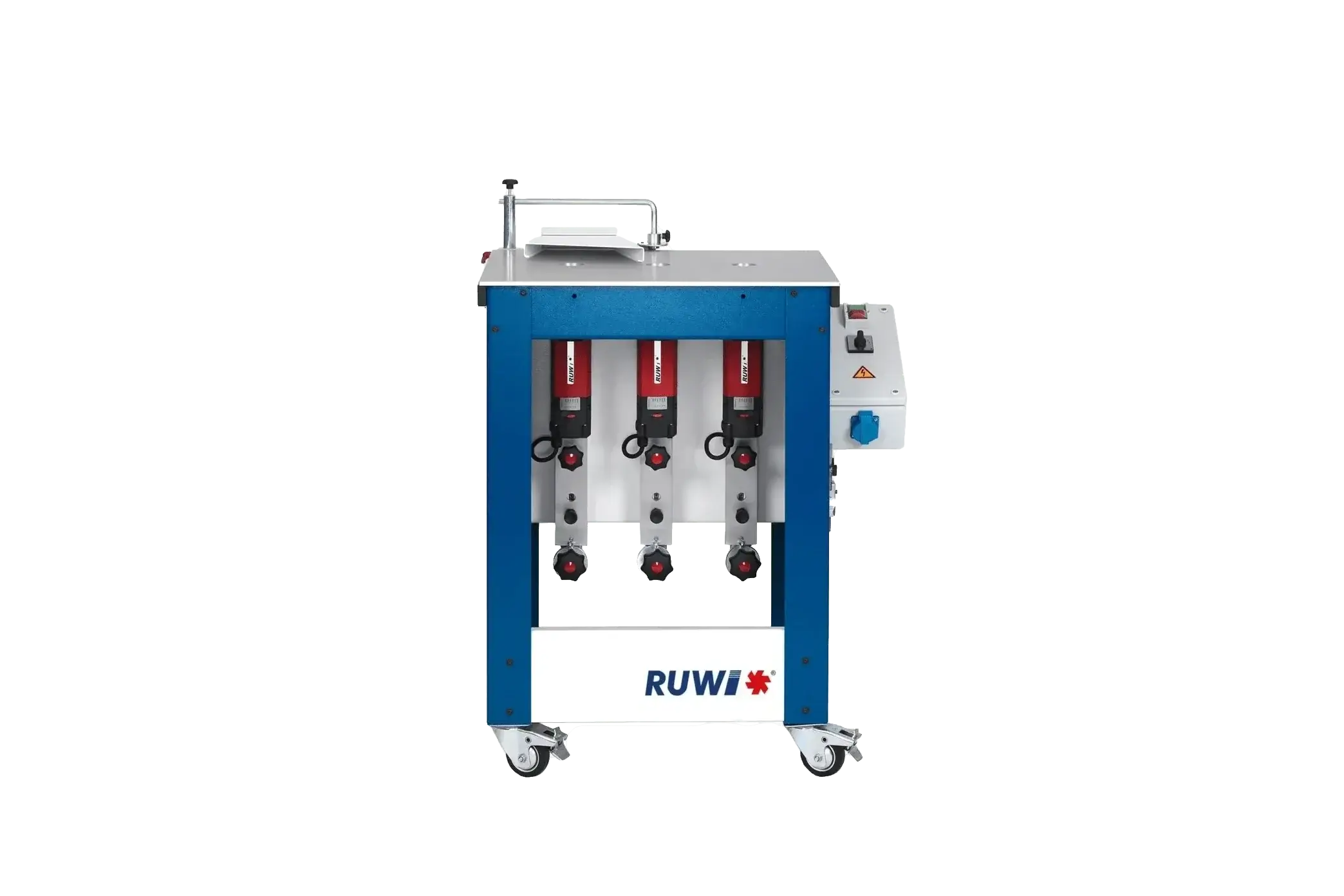
Switching between router bits takes setup time: removing the bit, clamping it in place, adjusting the height, and doing a test run. The RUWI router table keeps one to ten router bits ready for use at the same time, depending on the model. You simply move to the right motor instead of having to switch setups. It’s a complete, standalone table router on casters with built-in router motors—not a mount for your handheld router. On this page, you’ll find the four models, the accessories, and everything you need to make your decision, including the limitations.
Not sure how many spindles you need? Give us a call at +49 7402 8414—we'll figure it out in ten minutes. Or schedule a workshop consultation.
A Comparison of the Four Models
The key question: How many cutters do you want to have on hand at any given time? More spindles mean fewer tool changes and less setup time. Each cutter retains its set height, even when lowered below the table: just raise it back up and continue milling.


Prices include VAT, plus shipping costs. The second number is the net price for businesses.
For most workshops, the Classic strikes the right balance: Three cutters remain clamped at the same time—such as a chamfer, a rounding, and a “ slot ” for a cutting board series—saving setup time on every job. It’s our best-selling model for crafts, training, and small-batch production, available upon request as a Bestseller Package with fine adjustment and a stop ruler. If one cutter is usually enough for you, go with the Basic. The Classic Performance offers more power and tools up to Ø 55 mm, while the Premium features more spindles.
All four share the same design, tool cover, dual exhaust system, and a 910-mm “ working height .” They differ in table size, number of spindles, motor power, and the largest “ tool diameter.”
Move the table to the side
| Model | Table (mm) | working height (mm) | Spindles | Engine | RPM (revolutions per minute) | max. tool diameter |
|---|---|---|---|---|---|---|
| Basic | 520 × 430 | 910 | 1 | 1.050 W | 8,000–25,000 | Ø 40 mm |
| Classic | 640 × 500 | 910 | 3 | 3 × 1,050 W | 8,000–25,000 | Ø 40 mm |
| Classic Performance | 640 × 500 | 910 | 3 | 3 × 1,600 W | 3,500–30,000 | Ø 55 mm |
| Premium | 1,070 × 500 | 910 | 5, expandable to 10 | 5 × 1,050 W | 8,000–25,000 | Ø 40 mm |

And if you're torn between two models: fine adjustment, a stop ruler, a curved ruler, and table extension can be retrofitted to all four models later on. Only the Premium model comes with more spindles: It is factory-equipped with mounting points and power outlets for up to ten drive units. With the Classic model, the drive unit replaces an existing spindle. So if you start with three spindles today and need five tomorrow, you might as well go with the Premium right away.
"I've been using the RUWI underfloor milling machine for commercial purposes since 2011 and am very satisfied with it. The machine often runs for several hours at a time and is very sturdy and well-built. The short setup times and compact design are great!"
From the Workshop
In our "Workshop Stories" series, we visit businesses and ask what makes them successful. The business tells its story; we listen.

Do the Math Before You Buy
Before making a purchase, there are two figures you need to consider: how much it costs you to rewire the system today, and how much the router table will actually cost you after taxes.
How much will the re-tensioning cost you today?
Four numbers from your everyday life—the results add up right away. A change means: remove the cutter, clamp it in, adjust the height, and do a test run.
Setup takes you about 117 hours a year. At your hourly rate , that comes to €7,627.00, based on 220 workdays. How much time the router table saves you depends on how many of your cutters remain clamped in place permanently. For a home workshop, it’s the number of hours that counts: time spent milling instead of setting up.
With the multi-spindle concept, the most commonly used milling cutters remain clamped in place and preset. The configurator uses your figures to calculate the results with model-specific accuracy. If you don’t have your actual hourly rate on hand, the hourly rate calculator will determine it based on wages, productive hours, and overhead costs.
Investment Instead of Purchase
A RUWI router table is an asset that you depreciate over its useful life; it is not an expense that disappears upon purchase. By using declining-balance depreciation and the special depreciation under Section 7g, you can bring forward a portion of your tax liability to the first few years. What remains in the end depends on your business.
Run some calculations to figure out how much the router table will cost you after depreciation, and discuss the numbers with your tax advisor.
Workshop Consultant
Which router table is right for your workshop?
Four models, developed and built in-house in Fluorn-Winzeln. We’ll ask you the same questions we’d ask over the phone: tasks, materials, batch sizes. At the end, you’ll receive a recommendation with an explanation, a list of accessories, and the total cost. It takes about a minute.
Go to the ConfiguratorNo registration, no forms.

router table, Table Router or Router Table: What Is the RUWI router table
These terms often mean different things online. A “router table” is usually a table designed to clamp your own hand-held router underneath: The table serves as the mounting bracket, and you provide the router yourself. “Table router” is the umbrella term. The RUWI router table is an under-table router: a self-contained, roll-mounted machine with permanently installed router motors manufactured in Germany, featuring one to five spindles depending on the model, expandable to ten. Chamfering, slots, rounding, sanding, deburring, and flush milling: on wood, panel materials, plastics such as Plexiglas, Makrolon, and fiberglass-reinforced plastic (FRP), as well as soft metals like aluminum. When not in use, you can simply roll it away.
Compared to a router table with a handheld router, the “ router table ” does three things differently that can’t be replicated using multiplex and a insert panel: Each router bit maintains its height, even when lowered below the table. The motors maintain a constant speed under load. Tool coverage and dual exhaust systems are tested as a complete unit. If you’re building one yourself for a business or a school workshop, there’s an additional consideration: Legally, you become the manufacturer of the machine, which requires a risk assessment and CE marking. This doesn’t apply in your home garage; there, the only thing that matters is how often you use the router.
The RUWI router table bridges the gap between a hand-held router, a stationary spindle moulder, and a CNC machine: multiple cutters are ready for use at the same time and precisely adjusted for repeatable results; it handles frequently changing tasks, smaller batch sizes, and rework without the need for programming. This is why cabinetmakers and woodworkers use it for small production runs and one-of-a-kind pieces—from cutting boards with bevels, rounded edges, and recessed handles to handrails and stair treads. Industrial companies use it for rework and special cuts alongside CNC machines; apprenticeship workshops and vocational schools use it as a GS-certified machine (DGUV Test) with standard tool guarding; and businesses in the RV, caravan, and model-making industries use it for their mix of materials—including wood, plastic, and aluminum. If this sounds like your everyday work, the configurator will guide you to the right model.
Router Motor, Exhaust System, Safety
Each spindle is equipped with its own router motor, manufactured in Germany and designed for continuous operation: depending on the model, it delivers 1,050 or 1,600 W and features stepless speed control to ensure the cutting speed is matched to the material. soft start and control electronics keep the speed constant under load, while the return thread on the double-bearing steel spindle keeps dust away from the bearings. The standard motor holds the router bits via the collet Ø 8 mm, while the performance motor uses Ø 12 mm. The router motor is also available separately as a 1,050 W drive motor for replacement or retrofitting. You can find compatible router bits in the router bit assortment or via the router bit advisor.
The standard tool guard covers the router bit above the tabletop. The plastic insert ring keeps the gap around the tool small, and the guide rail guides the workpiece so that your hands remain on the workpiece. Dust and chips are extracted by the dual extraction system above and below the tabletop via a 120 mm diameter connection for stationary and mobile units. The extraction unit moves toward the active motor, and partitions in the lower channel prevent air leakage. Every router table is manufactured and tested in Fluorn-Winzeln. All other technical specifications can be found on the product pages for the four models.
Engine
- Rated Power
- 1,050 W Standard, 1,600 W Performance
- Operating voltage
- 230 V / 50 Hz, Schuko
- Rotational speed
- Standard 8,000–25,000, Performance 3,500–30,000 rpm
- soft start
- Yes, with inrush current limiting
- Tension Collar
- Ø 43 mm
- collet Standard
- Ø 8 mm, or 6 / 6.35 / 9.5 / 10 mm
- collet Performance
- Ø 12 mm, convertible to Ø 3 to 12.7 mm, including inch sizes
- Bearings
- double ball bearings, return thread to keep out dust
Extraction and Testing
- Vacuum connection
- Ø 120 mm, for stationary and mobile systems
- Extraction
- double, above and below the tabletop
- Tool Concealment
- standard
- Insert rings
- Plastic; keeps the gap around the tool small
- working height
- 910 mm for all models
- Conformity
- CE Marking, Manufacturer's Declaration
- Exam
- GS mark (DGUV Test), tested for wood dust

Accessories: Reuse Instead of Buying New
The router table is modular. Almost everything can be added later as your needs grow, and any parts that wear out can be replaced individually.
Expansion
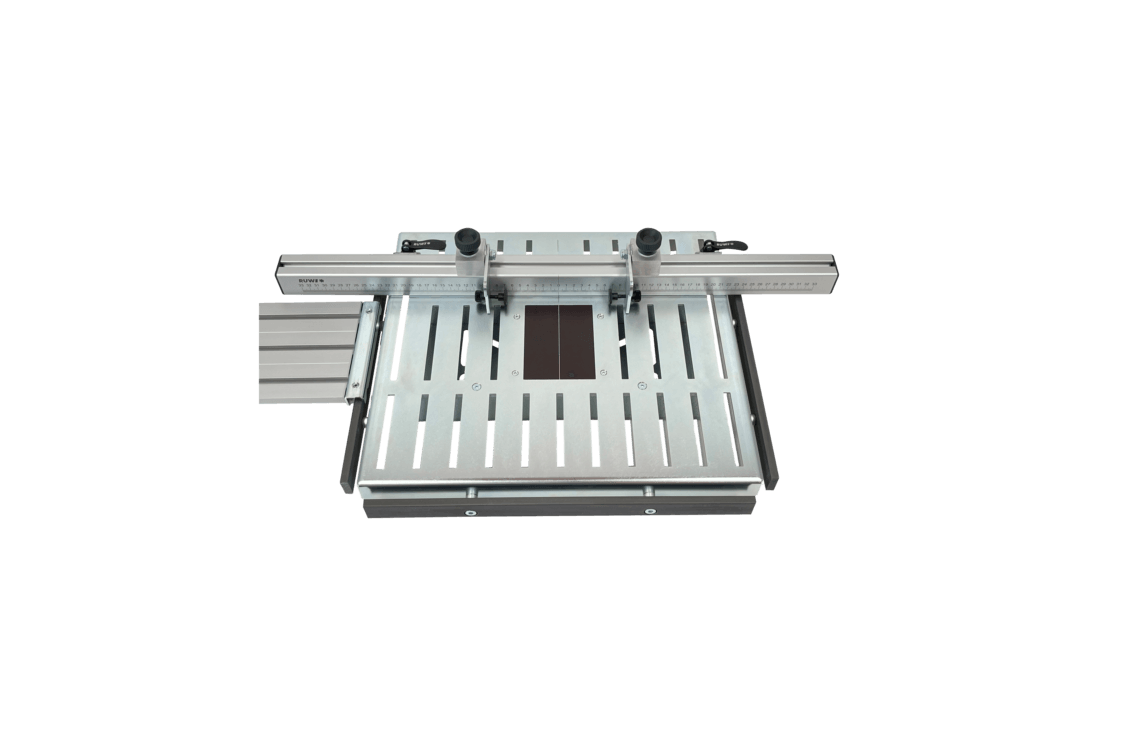
The drive unit consists of the complete router head with height adjustment: in the Premium model, this involves expanding the system to up to ten spindles; in the Classic model, it involves replacing an existing spindle. The fine-tuning mechanism adjusts the router bit height in 0.1-mm increments; this feature comes standard on the Classic Performance model, and is available as a retrofit kit for Basic, Classic, and Premium models—one kit per spindle—for tables manufactured starting in October 2024; We retrofit older tables in-house. The straight guide rail facilitates straight-line operations such as chamfering, slots , and rounding; the curved guide rail mills inner and outer radii, continuously; and the 3D milling unit machines multi-curved parts using two movable workpiece supports. For larger workpieces, you can mount the table extension tool-free on the side or front using the appropriate mounting kit.
 Drive unit for RUWI router table€954.25 €801.89 (net)
 RUWI Fine-Tuning for the " router table " (Retrofit Kit)€146.11 €122.78 (net)
 Ruler for RUWI router tablestarting at €364.69 starting at €306.46 (net)
 Curved Ruler for RUWI router tables€283.28 €238.05 (net)
 3D Milling Unit for RUWI router table€1,565.55 €1,315.59 (net)
 RUWI table extension for mounting railstarting at €198.60 starting at €166.89 (net)
 Mounting kit for table extension router tablestarting at €272.86 starting at €229.29 (net)
Small Parts and Replacement Parts
collets, hardened collet nuts and plastic spacer rings hold the cutters securely in place and keep the gap around the tool small. The high-performance motors come with their own collets and spacer rings. Parts that wear out are available individually: replacement carbon brushes, gas pressure springs, and the original 1,050 W drive motor. If a motor stops running smoothly, we repair it right here in-house.
 collet router table Basic, Classic, Premium with collet nutStarting at €65.59 Starting at €55.12 (net)
 Router Table Collet Performance with Collet Nut€70.07 €58.88 (net)
 Collet nut€26.10 €21.93 (net)
 Performance Collet Nut€26.10 €21.93 (net)
 Plastic insert ring for RUWI router table , Basic, Classic, Premium3.74 € 3.14 € (net)
 Plastic Insert Ring for RUWI router table Performance7.08 € 5.95 € (net)
 Replacement Carbon Set for RUWI router table , Basic, Classic, and Premium€19.68 €16.54 (net)
 Replacement Carbon Brush Set for RUWI router table Performance€25.94 €21.80 (net)
 Gas spring for RUWI router tablestarting at €19.68 starting at €16.54 (net)
 RUWI router table Drive motor 1050 watts523.68 € 440.07 € (net)
 Drive Motor Repair RUWI router tablePrice upon inspection
Partner
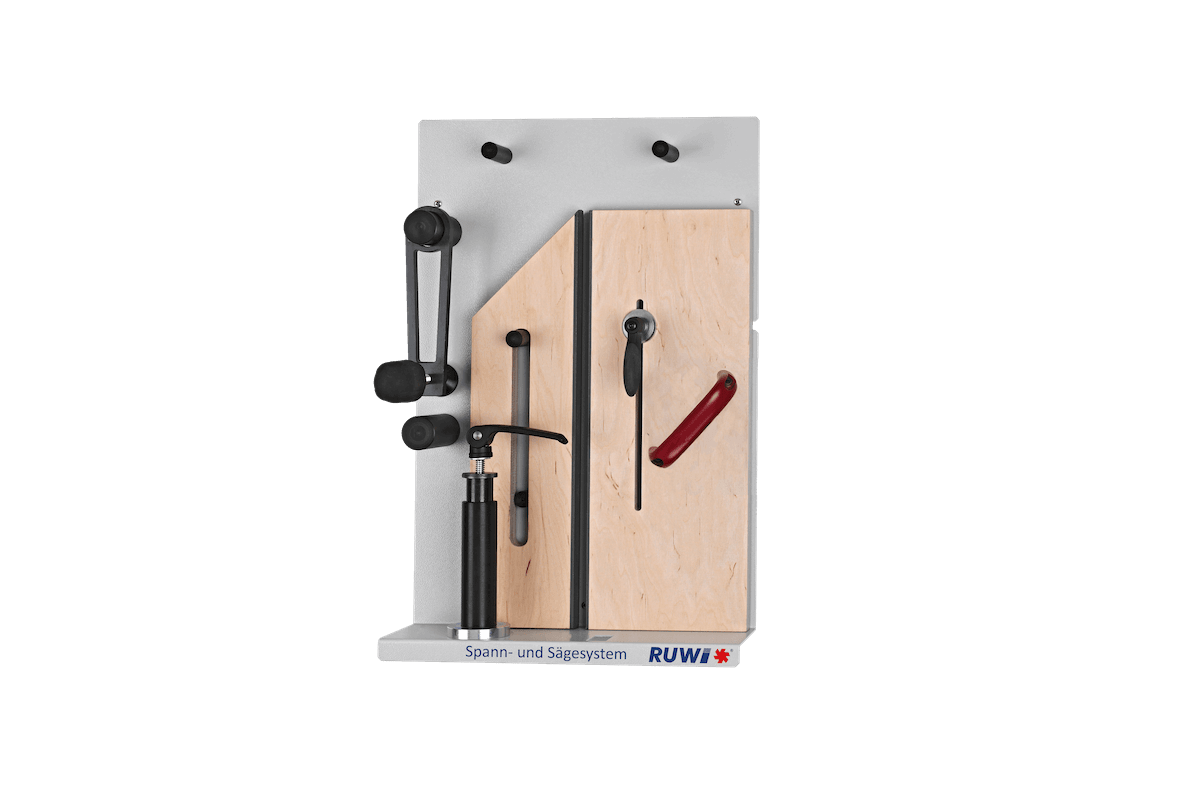
The AIGNER Contermax is a cross-clamping vise for profiles and counterprofiles at the end face: The splinter block supports the exit edge, the long handle keeps the hand at a safe distance from the tool, and changing workpieces is a breeze tool-free.

Which parts fit which model?
Move the table to the side
| Accessories | Basic | Classic | Classic Performance | Premium |
|---|---|---|---|---|
| Ruler | Yes, Basic model | Yes, Classic model | Yes, Classic model | Yes, Premium version |
| Fine-tuning | Retrofit kit, one per spindle | Retrofit kit, one per spindle | standard | Retrofit kit, one per spindle |
| Additional Drive Units | no | only as a spindle replacement | no | Up to 10 spindles, factory-prepared |
| Curved Ruler | yes | yes | yes | yes |
| 3D Milling Unit | yes | yes | yes | yes |
| table extension with mounting kit | Basic Set | Classic Set | Classic Set | Premium Set |
| collets, collet nut, spacer ring | Standard | Standard | Performance | Standard |
| Replacement charcoal | Standard | Standard | Performance | Standard |
| Gas-filled springs | Basic Set | Classic Set | Classic Set | Premium Set |
The curved ruler requires the stop ruler. With the Classic Performance, the stop ruler and mounting kit from the Classic version are compatible because both tables have the same table surface.
Here's how the " router table " comes to you
Three things you'll want to know before placing your order: how your order will be delivered, what you'll need to set it up, and what happens if you need service.
Fully pre-assembled and shipped via a freight carrier
Your router table arrives fully assembled on a pallet; the Classic model measures 1,200 × 800 × 1,000 mm and weighs 109 kg. Schenker usually delivers within about three business days, or on a date of your choice—which you can arrange directly with them by phone.
Plug it in and start milling
Roll off the pallet, insert, mill: The motors run on 230 V; a three-phase connection is not required. The Ø 120 mm exhaust port fits both stationary and mobile systems. The Classic, Classic Performance, and Premium models are mounted on four castors with brakes, while the Basic model is mounted on two transport casters.
Service from Fluorn-Winzeln
We keep spare parts in stock for at least ten years after the date of manufacture—and in practice, even longer. Wear-and-tear parts, such as replacement carbon brushes and gas springs, are available individually. If a motor is no longer running smoothly, we repair it right here in-house. After the two-year statutory warranty expires, we’ll work with you to find a solution on a case-by-case basis. This is not a warranty in the legal sense; your statutory rights remain unaffected.
For Procurement in the Workplace and Schools
If you're handling the procurement process internally, you'll need documentation rather than arguments. Here's what you'll need for your boss, the support association, or the chamber, along with a quick guide to preparing a written proposal.
Routes and Documents
- All four models are in stock and will be shipped via a freight carrier in approximately three business days.
- Demonstration at a partner retailer near you, via video call, or at our location in Fluorn-Winzeln
- Purchase directly from the manufacturer, through specialty retailers, or from wholesalers
- You can get the data sheet, GS certificate, and operating instructions upon request
- Written Quote for Businesses, Schools, and Vocational Training Centers
- Special rates available for two or more tables upon request
Request a Quote
Tell us what you have in mind. We'll get back to you within one business day with an honest assessment—even if another solution is a better fit.

Not a sales pitch, but a workshop consultation
Talk to the master carpenter who developed the router table
Reiner Ruggaber built the first RUWI router table for his own woodworking shop to streamline operations in his workshop. He’ll work with you to determine how many spindles, what power rating, and which accessories are right for your business—based on your actual work, not just a spec sheet—whether on-site in Fluorn-Winzeln, via video call, or at a specialty retailer near you. Bring your results from the configurator with you so we don’t have to start from scratch.
Or check it out at a specialty store
Want to see and try out the router table before you decide? The map shows our retail partners. Often, you can get the answer to that very question without having to travel far.