
Here's what's included
• 3 × CUnex jigsaw blades W1, W2, and W+P2
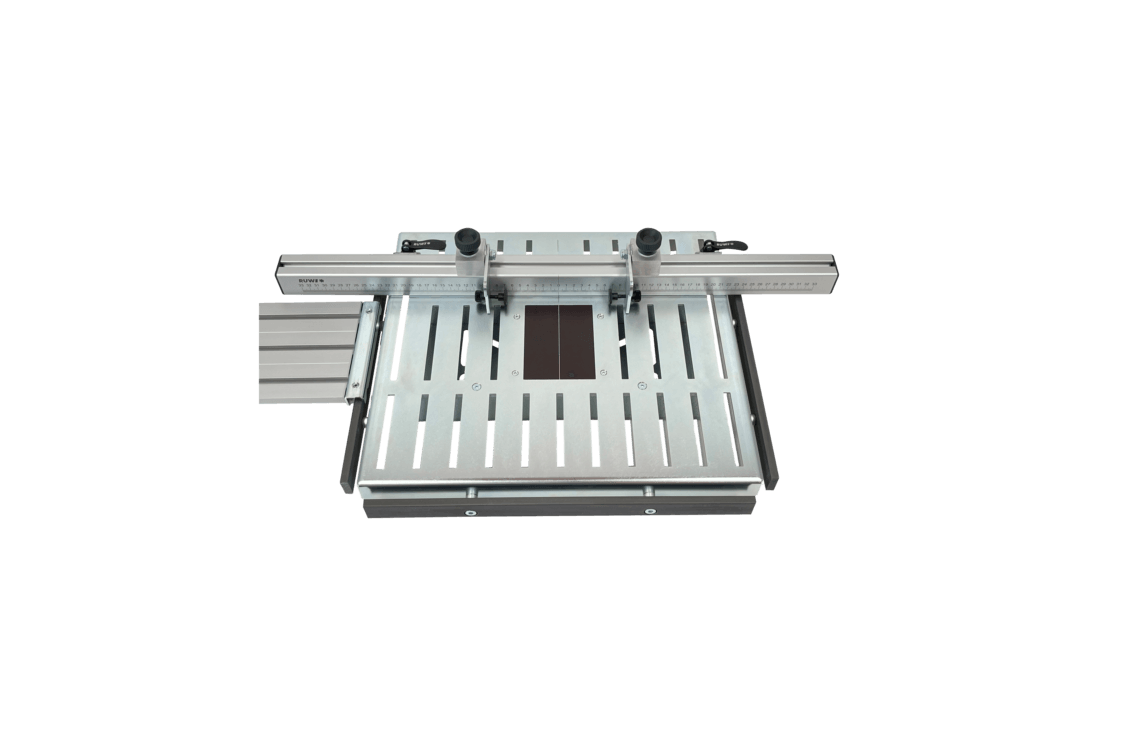
• 1 × P-PA rip fence
• 1 × P1-GP base plate
• 1 × P-AS dust extraction nozzle
• 1 × P-SA chip deflector
• 1 × P-SS chip guard
• 1 × P-G glider
• 1 × 4 m connection cable
• 1 × T-MAX system box
The sink cutout in the countertop, the cooktop, the vanity. Curves and sweeping trim, notches, custom cuts along slanted walls and around pipes—and all cutouts in already-installed cabinetry where no track can be added. Two scenarios will show you that you’ve come to the right place: tight radii in thick material that need to emerge at right angles from the cut, and a custom-made interior cutout.
No guide jaws, no pressure roller—by design: Guidance creates friction, friction generates heat, heat softens the blade, and soft blades wander. The P1 cc allows the blade to run freely; the CUmax clamping force secures it via a wedge in a positive-lock fit, and the rigidity comes from the wedge-shaped CUnex blade itself. Measured, not claimed: A technical college for wood technology measured a 0.3° angular deviation at a blade temperature of 34 °C after 2 m of wave-cut in 28-series particleboard—the competing models of that era had deviations of 1.7° or more, at temperatures up to 94 °C. And you’re not locked in: The CUmax holder accepts any T-shank —affordable third-party blades are sufficient for simple cuts; we’ll be honest with you about that.
The fact that you’re buying the Mafell saw at RUWI isn’t a given: We’re manufacturers ourselves—tools for woodworking professionals from Fluorn-Winzeln, 4 kilometers from the Mafell factory in Oberndorf am Neckar. We carry only what we can recommend based on our own experience—including the test results below, which aren’t exactly flattering.
Here's how to use it
- Cutting cutouts: sink, cooktop, vanity—even in built-in cabinets.
- Cutting tight radii at right angles: the rigid CUnex does not wander—even down to 16-mm holes, it cuts with virtually no tear-out (technical college measurement).
- Precision cutting: four pendulum stroke settings plus a zero position; stroke count continuously.
- Clear visibility without a suction cup: the built-in suction channel and air-blow function keep the cutline visible.
Does this fit in your workshop?
Once a straight cut goes all the way through the plate and the guide rail is in place, the plunge saw is faster and cleaner; for a series of identical cutouts, it’s more cost-effective to use a router with a template. The miter function is only available as an accessory via the swivel plate—with the plate mounted, the dust extraction and chip guard are not required. And since honesty is also important: Stiftung Warentest gave the P1 cc a “good (2.0)” rating in 2016—placing it last in the test group, with criticism of the sensitive switch. The performance metrics listed above are the reason why professionals buy it anyway. If you want to work cordlessly, check out the PS 2-18.
You can read about why your vacuum should be Dust Class M in the knowledge article on wood dust extraction —and the Machine Advisor will help you find the right saw by asking you two or three questions.
All the details
