





Panel storage in the woodshop: more than just a shelf
When people think of panel storage, the first things that come to mind are shelves, compartments, and storage spaces. When we moved our production and carpentry shop to the new building , we started with exactly this question: How will we store our panels in the future? The longer we thought about it, the clearer it became: It’s not just about the shelving.
Why the Shelf Is Only Half the Answer
What matters much more is how the material moves through the workshop later on. After all, a sheet of material doesn’t become more productive just because it’s stored properly. What matters is how quickly it’s available, how often it needs to be moved, and whether it reaches the machine safely.
How many trips should a panel make?
We don't use a panel cutting saw; instead, we cut our panels directly on the sliding table saw . That's why this issue was more important to us than any shelving design. Every additional movement costs time, and every unnecessary transport increases the risk of damage.

Cutting directly on the sliding table saw —every step of the way counts
Instead of focusing on shelf heights and compartments, we therefore started by thinking about the flow of materials: Where do the panels arrive? Where are they stored? Where are they processed? And how often do they need to be moved between these locations?
Why We Chose a Vertical Panel Storage System
When building a new facility, there’s often a tendency to want to allocate as much storage space as possible. Instead, we asked ourselves which materials really need to be available at all times. After all, every additional storage space takes up room and ties up capital. The challenge isn’t to store as many panels as possible, but to keep the right panels on hand exactly where they’re needed.

Panel Storage in the RUWI Woodshop
Due to the limited space available, we decided on a vertical panel storage system. It was immediately clear that this wasn’t just a matter of space. Panels must be stored securely and be easy to remove and move. Especially with large-format materials, workplace safety and transportation quickly become just as important as storage.
From storage to the saw
One thought kept coming back to us during the planning phase: The shelf solves only part of the problem. That’s why we considered early on how the panels would be transported from storage to the machine. Whether you use a panel cart, a panel swivel device, or a solution we developed ourselves depends on your workflow.

Panel-swiveling device in action: removed in an upright position, transported to the saw in a horizontal position (Photo: Felder Group)
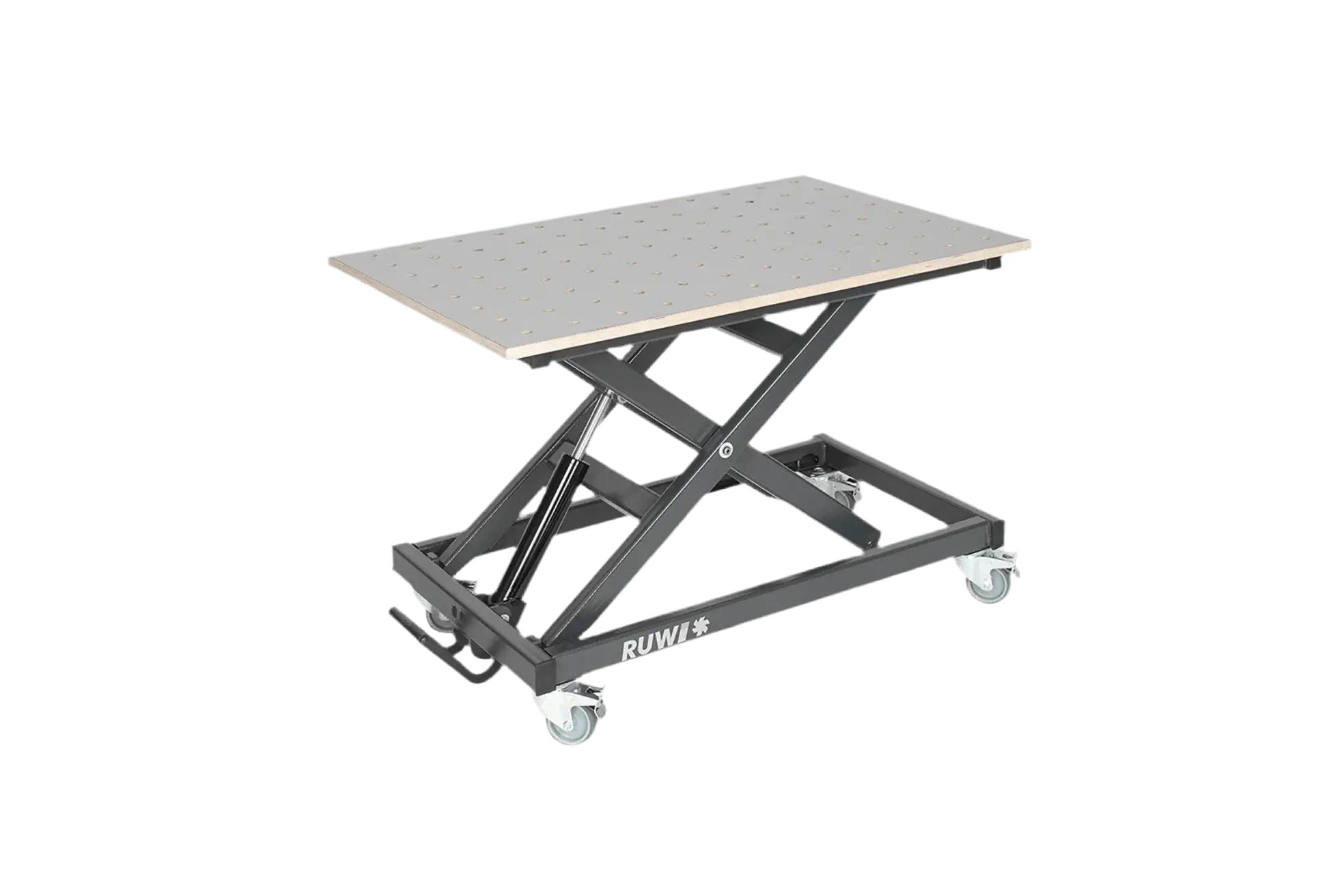
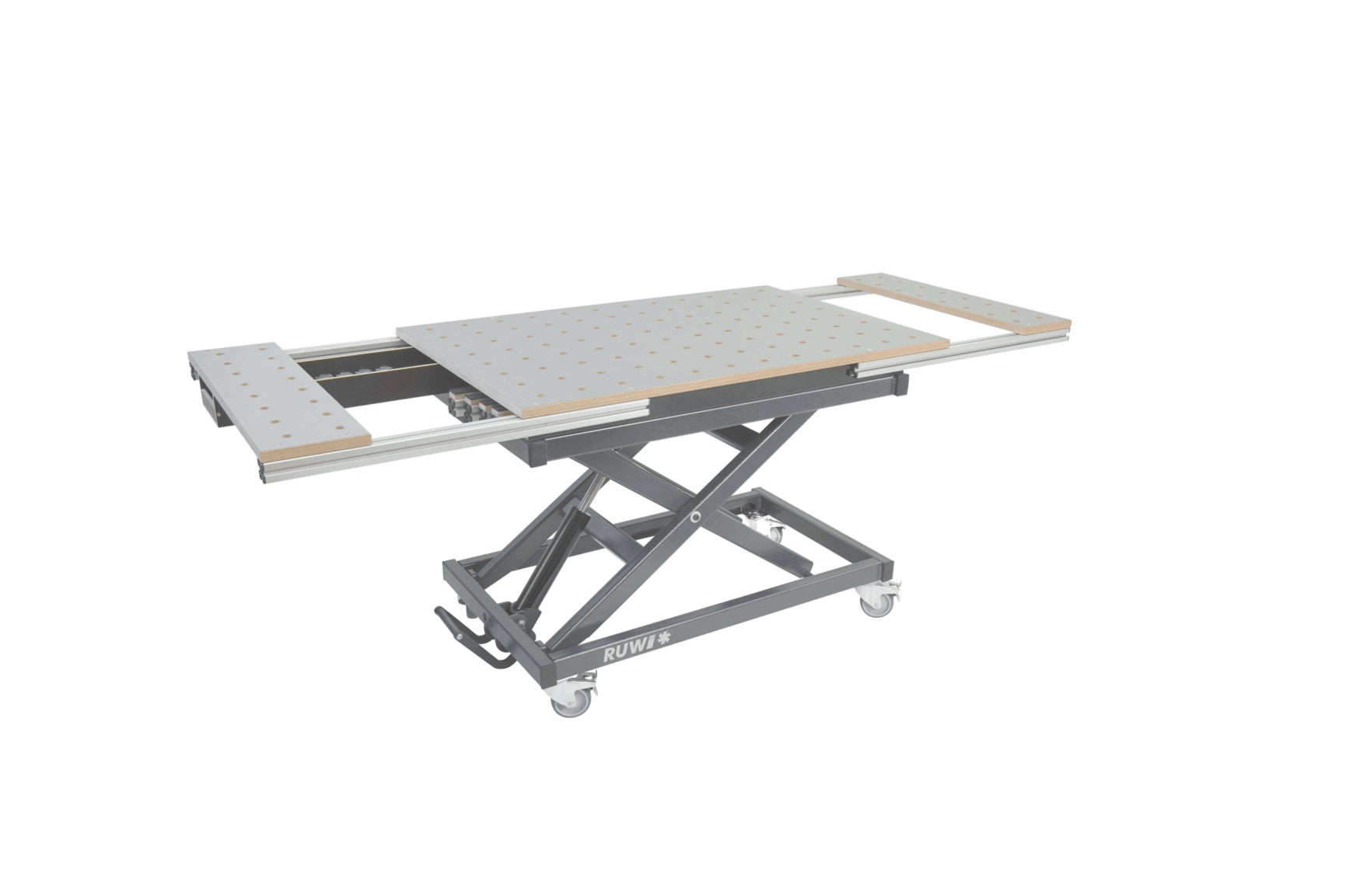
Our colleagues at JPC-Wood show what such a custom solution can look like: They converted a RUWI lifting table into a panel swiveler that tilts the panel around its own center of gravity instead of lifting it. The trade magazine BM features the conversion in issue 02/26, and a set of plans for replicating it is included.

In-house-developed panel swivel based on an RUWI lift table (Photo: JPC Wood)
Why We Still Choose Not to Use Additional Aids
Sometimes, however, the right answer is to consciously choose not to use something. When distances are short, as they are here, and slabs are always moved by two people, that can be exactly the right solution. We usually work with two simple carrying handles and the lifting table. This fits our workflow and is perfectly sufficient for the transport tasks we face.

The two of us at the saw—our vertical panel storage in the background
In our view, what matters most is not so much the specific piece of equipment as whether the material can be moved safely, in a controlled manner, and without unnecessary effort.

Simple carrying handles, conveniently mounted on the wall
Three Questions for Your Panel Storage
- Where do most of the panel movements occur? Plan your storage layout starting from the saw, not from the open wall. Every step you save pays off with every cut.
- Which materials really need to be available right away? Every additional storage space takes up room and ties up capital. Keep the right sheets on hand—not as many as possible.
- Can the material be moved safely? Especially when it comes to large-format panels, workplace safety and transportation are just as important as storage itself.
As is so often the case in the trades, there isn’t just one right solution for panel storage. Ours fits our workflows and circumstances—in your workshop, the answer might look different. Perhaps that’s the most important insight of all: When we were moving, we initially thought about a panel rack. Looking back, we were actually talking about material flow. The rack was merely the visible result of those considerations. After all, the most interesting questions rarely revolve around the design itself, but rather around the processes it’s meant to support.


