





Clamping Workshop: All the Options
Better Guided, in Five Steps3D clamping scene based on our CAD data
Enter your own measurement
Why is that, and how do you set it up?
Other Clamping Situations
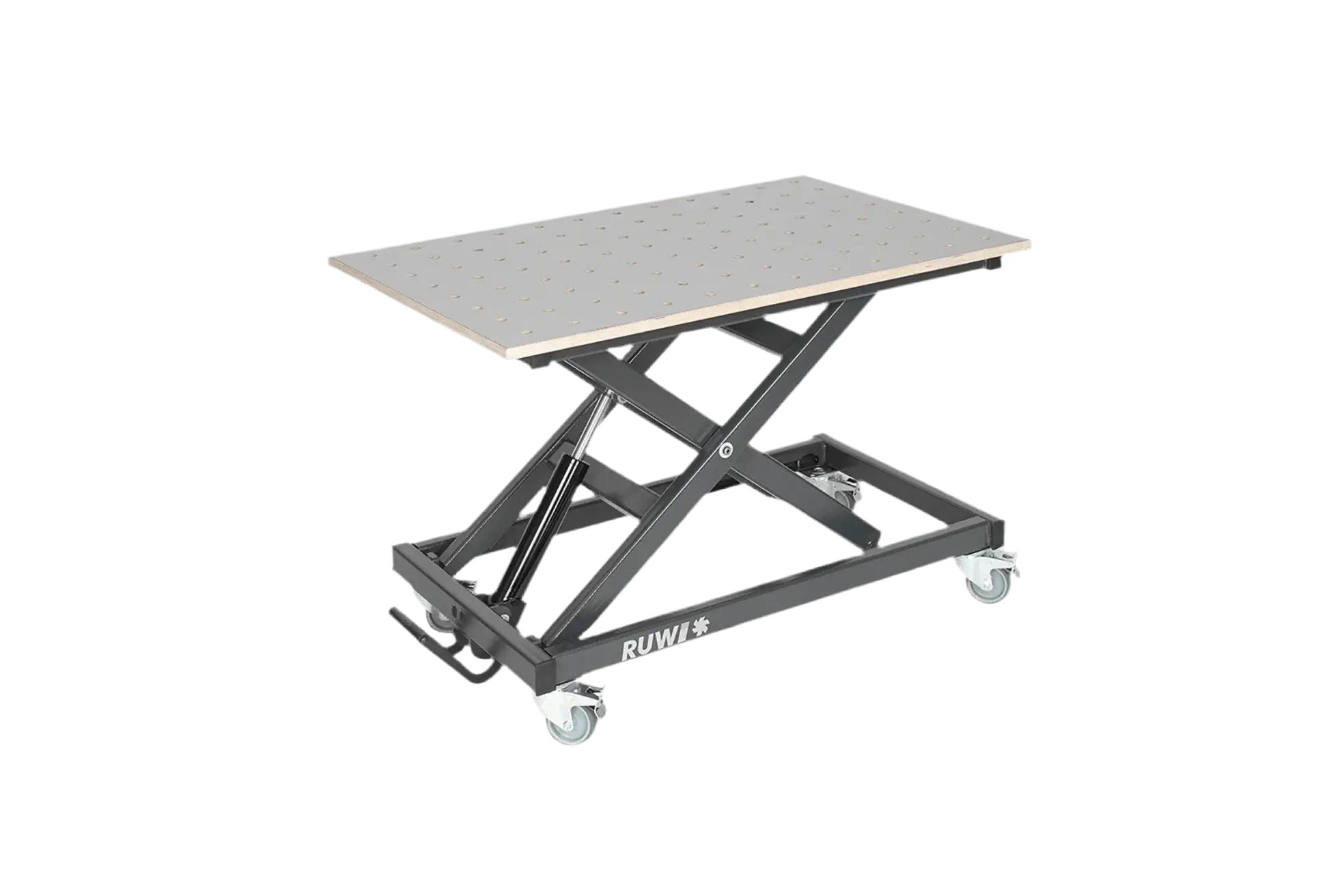
Dimensions of this table
Why this amount?
This table is not height-adjustable. We demonstrate the working height on the RUWI height-adjustable tables.
We display the working height in 3D view, and that doesn't work on this device.
plus shipping; you'll see the cost at checkout.
Workshop Consultation on This WorkpieceWe'll get back to you within one business day with an honest assessment of your workpiece.
Does this work for your workpiece? Give us a call: +49 7402 8414.
Where the numbers come from
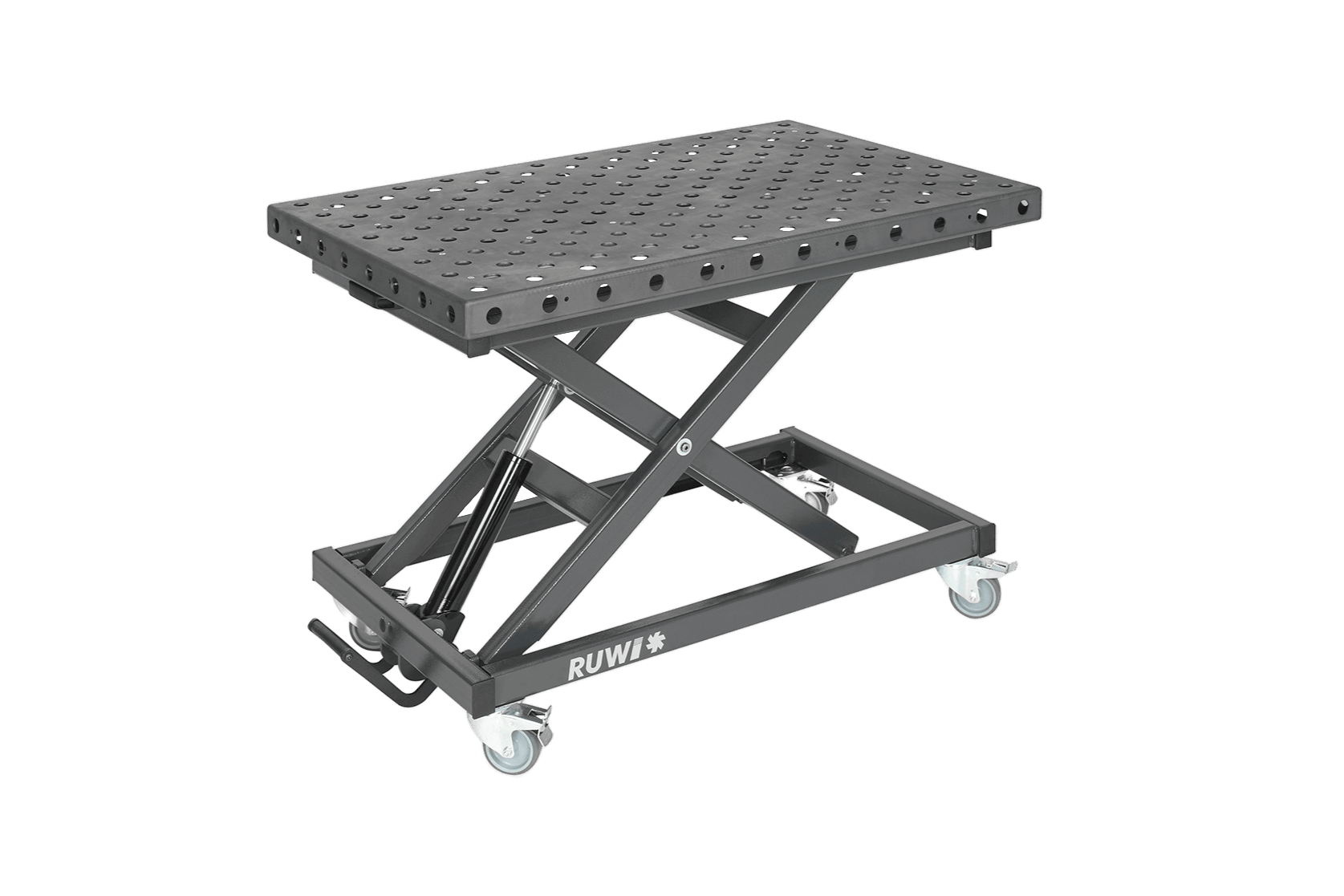
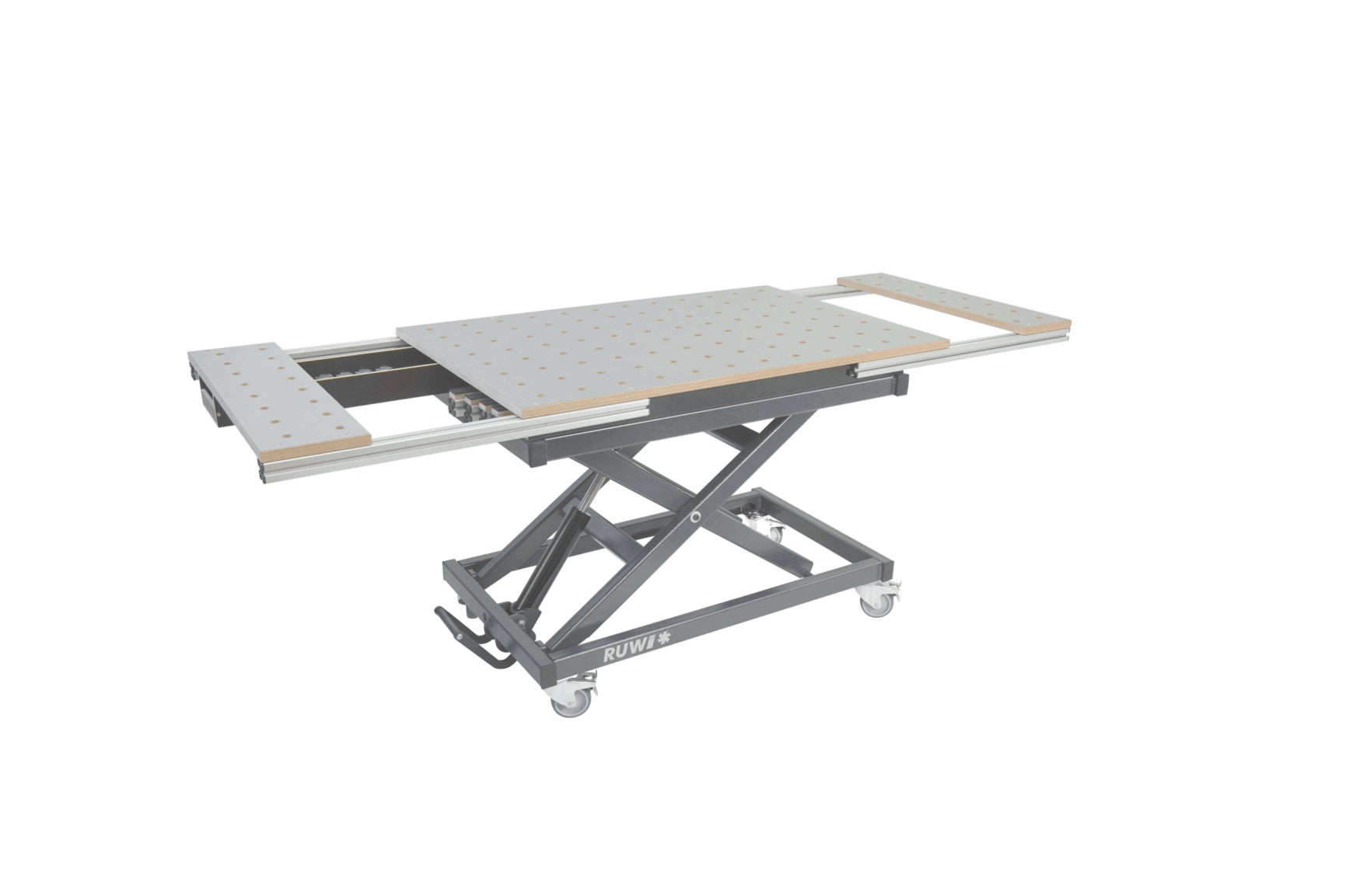
This page shows two hole grid: Ø 20 mm in a 96-hole pattern for wood and Ø 28 mm in a 50-hole checkerboard pattern for the welding table. For aluminum profiles with T-slot, welding table with Ø 16, and the RUWI drilling table , the Clamp Finder guides you to the part number in three questions—there are 52 parts listed there.
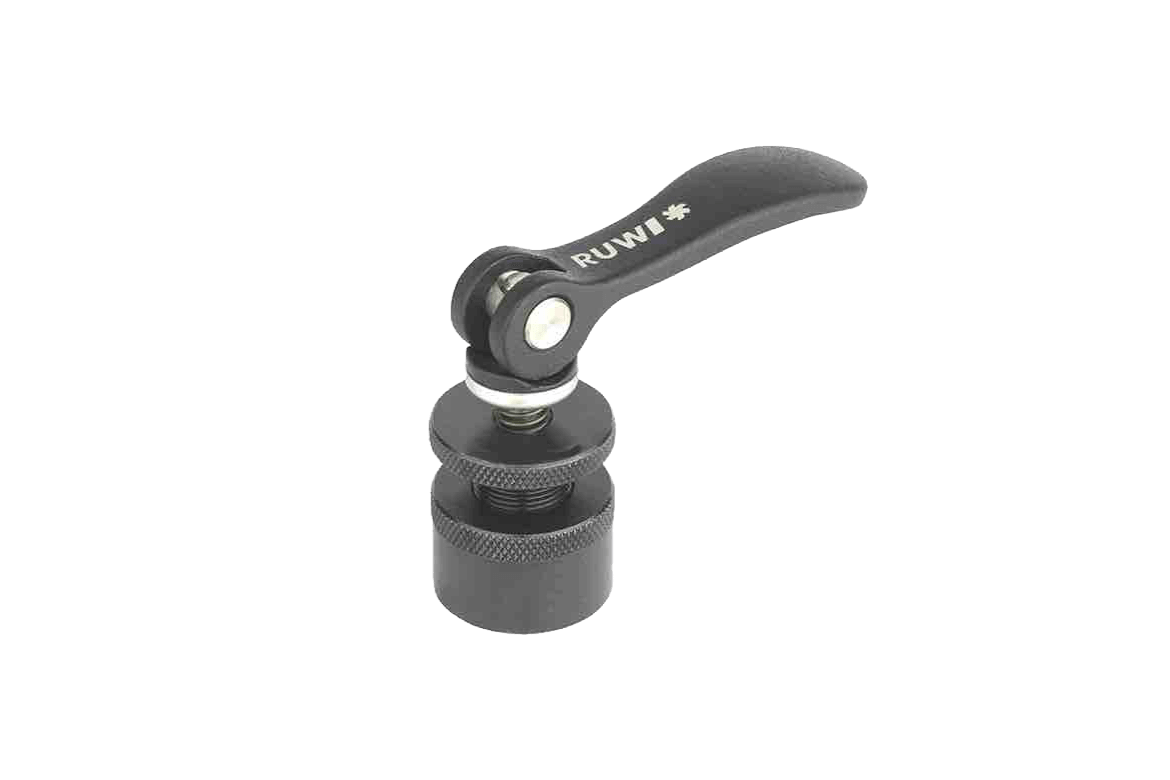
Every part in the scene comes from a CAD file: horizontal toggle clamp, vertical toggle clamp, eccentric clamp (with plate), and pivot bearing, positioning angle, support rail, clamping bolt —as well as the tables themselves. We are not replicating any of these parts. The workpiece, on the other hand, is not a real one: the board, frame, and door are shown there as placeholders with realistic dimensions. For the horizontal toggle clamp , the lever travel is estimated; in the drawn position, the cap is 113 mm in front of the hole and can be adjusted by 25 mm. The 3 kN applies to the clamp, not to the connection to the panel. The hole patterns on the models were counted, not calculated. The eccentric lifts 3.55 mm as measured on the model; KIPP specifies 4 mm for the identically constructed part. The hole pattern for both welding tables has been counted on the model: 173 grid positions in a 50-grid checkerboard pattern, of which 167 are round holes with a diameter of 28 and 6 are slotted holes measuring 47 × 28 mm, with a deviation of 0.000 mm. Prices: In the online store, prices are displayed live from the product data; gross prices are as listed by the store, and net prices are calculated from those—the store includes VAT in its pricing. Outside the online store, the net prices as of September 9, 2026, are listed, calculated gross with 19% VAT.
working height: In the Premium and Classic 300 XL versions, the view moves the scissors based on the CAD file: there, the arms are separate bodies and rotate around the intersection point measured on the model. The Basic and Classic versions are based on the base frame 300 (21001). There, the frame and arms are drawn as a single body; we divide it—based on the orientation of its faces—into the base frame, upper frame, and the two pairs of arms, without redrawing anything. This allows all four lifting tables to move independently. The figure serves as a scale model rather than a physical model: joint positions are calculated as a percentage of total height based on the body proportions described by Drillis and Contini (1966), with the elbow set at 0.630—the same value used to calculate the table height. She grasps the workpiece with both hands and rounds her back when her arms otherwise cannot reach. If the table is too low, she bends her knees before her back rounds further—just like in real life. The height for each application follows a rule of thumb from ergonomics based on Grandjean and is not a measured value: light work 10 to 15 cm below the elbow, work involving downward force 15 to 40 cm below. We calculate based on the upper edge of the workpiece and body height without shoes. The specific distance we choose within these ranges for each task is based on our judgment. Status r109.